News

News & Events

Pacific Wave, Cal Poly Humboldt, and Internet2 Collaborate on Connectivity to Singapore, Guam, and Jakarta

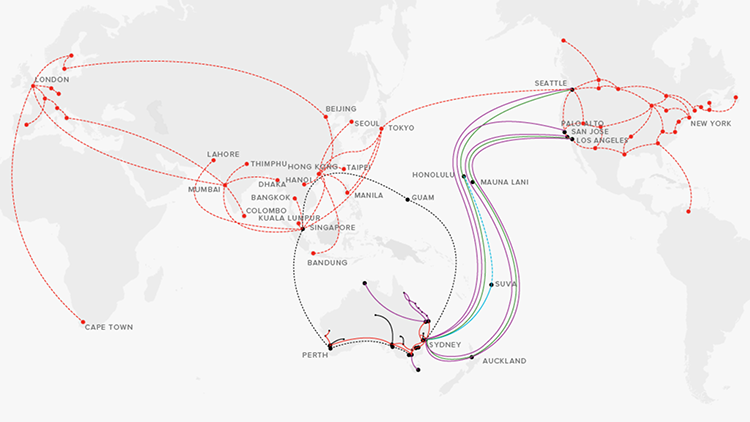
SAN FRANCISCO, CA and SEATTLE, WA – Pacific Wave today announced its successful partnership with FLAG, one of the world’s largest privately owned subsea cable networks, for new capacity on the state-of-the-art Echo subsea cable system, significantly expanding connectivity between US university research institutions and their partners in Singapore, Guam, and Indonesia, empowering this global research community with greater speed, reliability, and capacity for their common endeavors.

This upgrade of the Pacific Wave Exchange, a major milestone for trans-Pacific R&E connectivity, will provide a dedicated and resilient path for researchers, students, and institutions to collaborate on data-intensive projects with partners across the region.

Cal Poly Humboldt, a foundational partner in this initiative, played a crucial role in enabling this connection. "Our North Coast location is a critical hub for global data, and we are proud to continue our role in facilitating high-speed access to the Pacific Rim for the R&E community," said Bethany Gilden, Acting Chief of Staff to the President at Cal Poly Humboldt.

As a leader of the nation's largest four-year public university system, the CSU Chancellor's Office provided strategic leadership and support for the project. Its advocacy ensured that this critical infrastructure would benefit students and faculty system-wide, strengthening the CSU’s commitment to academic innovation and international collaboration.

"This new capacity on the Echo cable is a game-changer for U.S. research and education, and particularly for the California State University (CSU) system," said Kendra Ard, Chief Infrastructure Officer, at the CSU Chancellor's Office. "Our ability to connect at high speeds to key research hubs in Singapore, Guam, and Jakarta will unlock new possibilities for data science, environmental studies, and international academic partnerships for all CSU researchers and students."

As the other foundational partner in this initiative, Internet2—the U.S. national research and education network—will integrate this new international capacity into the broader R&E network ecosystem.

“The research and education community has a long history of collaborations to provide transoceanic capacity, enabling and advancing global discovery,” said Howard Pfeffer, President and CEO of Internet2. “Internet2 is proud to work alongside Pacific Wave, Cal Poly Humboldt and the CSU Chancellor's Office to bring this new capacity to empower researchers, educators, and scholars to connect and drive innovation worldwide.”

Key benefits of the Pacific Wave expansion via the Echo cable include:

  • Direct Connectivity: A new, direct express route connecting the West Coast of the US to Singapore, with branching connections to Guam and Jakarta, offering lower latency than traditional paths.

  • Enhanced Resilience: Adds geographical diversity to the existing transpacific R&E networks, increasing overall resilience and reliability for R&E traffic.

  • Support for Data-Intensive Research: Provides the necessary high-bandwidth capacity to support major multinational scientific projects involving big data.

"We are incredibly proud to collaborate with our partners Cal Poly Humboldt, Internet2, the CSU Chancellors Office, and with support from the National Science Foundation, to bring this essential new capacity online," said Louis Fox, President & CEO of CENIC, which, together with the Pacific Northwest Gigapop, has operated Pacific Wave for two decades. "The Echo cable system provides a direct, high-speed connection between the U.S., Guam, and Southeast Asia, and it is critical for enabling next-generation research. This expansion will significantly benefit our member institutions and their partners, fostering greater international collaboration in fields like AI, climate science, genomics, oceanography, and astronomy."


Pacific Wave: pacificwave.net

Internet2: internet2.edu

Cal Poly Humboldt: humboldt.edu

Cal State University Chancellor’s Office: calstate.edu

Jonah Keough
Pacific Wave Supports Big-Data Demonstrations at Supercomputing 2024 Conference

This year at the upcoming Supercomputing 2024 (SC24) conference, Pacific Wave infrastructure will be supporting numerous Network Research Exhibitions (NREs) showcasing methods to improve and accelerate international scientific discovery, collaboration, and analysis.

As big data gets ever bigger, researchers around the world have learned that managing these data flows is more than a matter of building bigger and bigger pipes. The challenges of managing the network and scientific workflows, as well as integrating globally distributed resources into a flexible infrastructure that meets the needs of many disciplines, have grown equally in pace with the data rates.

The NREs taking place at the annual Supercomputing conference seek to address these challenges so that scientific discovery continues and researchers are empowered by the data bounty they have created rather than being overcome by it.

Integrating International Compute, Storage, and Visualization Resources, and More

The North America Research and Education Exchange (NA-REX) is a collaboration to improve research and education networking in North America, and by extension globally, enabled by participation in open international Research and Education (R&E) exchange points and national and regional R&E networks. The collaboration is designed specifically to support R&E communities to accelerate science research, especially multi-domain science, data-intensive science, and research testbeds by developing an international infrastructure based on 400 Gbps end-to-end paths interconnecting major open exchange points. Other service components include open exchange Data Transfer Nodes (DTNs), and AutoGOLE/NSI dynamic provisioning.

The NA-REX infrastructure, along with Pacific Wave, StarLight in Chicago, and other resources, will support several NREs, including the Global Research Platform (GRP). The GRP will demonstrate techniques that dynamically create powerful, distributed, integrated systems of computers, data storage, visualization displays, and instruments at collaborating sites around the globe, making it easier for researchers to share resources, innovations, information, and knowledge. NA-REX itself will also conduct its own multi-booth international demonstrations using 400 Gbps paths along Pacific Wave, StarLight, and Internet2’s WIX to the SC24 venue in Atlanta.

Supporting Near-Terabit International Data Transfers and Application Use

Pacific Wave, as part of the APOnet collaboration, is supporting NICT and NII experiments such as demonstrating 800 Gbps data-transfer from Japan to the United States using Massively Multi-Connect File Transfer Protocol (MMCFTP), as well as demonstrating Tbps-scale Network Layer Anonymous Communication on Programmable Switches which offers improved security and reduces the amount of equipment required at each endpoint.

Another demo by Osaka University in Japan seeks to improve the memory-to-disk performance which may enhance the ability of researchers to analyze research data quickly. Five of the ten pathways across the Pacific used for these demonstrations will be facilitated by Pacific Wave and other collaborating international networks.

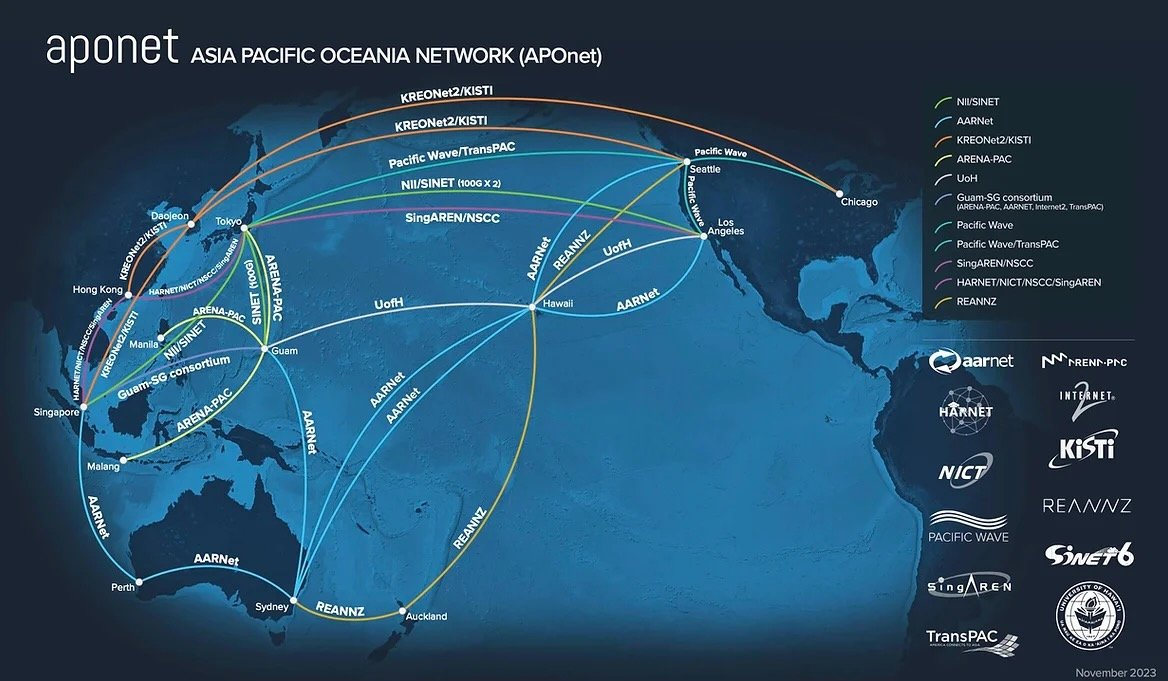
APOnet Asia Pacific Oceania Network Map

Improving Management of Large-Scale Network-Enabled Scientific Workflows

The SciTags initiative is an open international collaboration developing practical networking capabilities for High Energy Physics (HEP) research using National Research and Education Networks (NRENs), including the LHCOPN and LHCOne. SciTags is being developed to provide high-fidelity visibility into how science flows utilize network resources end-to-end, allowing R&E networks to better understand resource utilization and manage large-scale scientific workflows.

The demonstration will showcase the management of internationally distributed resources at a variety of Open Exchange Points over 400 Gbps paths provided by Pacific Wave, StarLight, CANARIE, the Metropolitan Research and Education Network (MREN), and NA-REX.

Dynamic Service Provisioning for Petabyte Data Exchanges

The Global Network Architecture Group (GNA-G) AutoGOLE/SENSE working group will also be presenting several demonstrations and experiments to showcase the global persistent multi-resource infrastructure based on the integration of the AutoGOLE and Software-defined network for End-to-end Networked Science at Exascale (SENSE) functions.

One SC24 demonstration will be showing workflows which include the resources in connected external facilities. Another demonstration will show data movement systems that can interact with the network to optimize their operations.

Integrating Internal and External Distributed Resources

Another set of demonstrations will show the FABRIC (Adaptive Programmable Research Infrastructure for Computer Science and Science Applications) infrastructure in operation.  FABRIC is an international infrastructure that enables cutting-edge experimentation and research at scale in the areas of networking, cybersecurity, distributed computing, storage, virtual reality, 5G, machine learning, and science applications.

The multi-booth FABRIC demonstrations for SC24 will highlight the many methods available for connections to external resources such as edge/site resources and other networks. This includes connections to multiple National Research Platform (NRP) sites and other R&E Networks, showcasing the FABRIC Research Cyberinfrastructure and the ease with which other resources and sites can be integrated.

Visit Pacific Wave at Booth 811

Data rates have grown exponentially since the early days of networked science and show no signs of stopping. These demonstrations and more will be supported by Pacific Wave during Supercomputing 2024 in Atlanta, Georgia, November 18-21, and thanks to them, visitors to the show floor can see how network researchers are preventing the challenges of managing this data from growing at the same rate.

If you’d like to learn more about Pacific Wave or the NREs that Pacific Wave will be supporting at SC24, please visit Booth 811.  You can also find a list of all accepted NREs at the SC24 website.

Pacific Wave Supporting FABRIC Coast-to-Coast Terabit Testbed with Connections in Los Angeles and Seattle

The global expansion of the Internet has revolutionized nearly every aspect of human society, and even greater transformations lie ahead.  Furthermore, many of these coming transformations will change not only how we do things but networking itself.  To ensure that the US’s K-20 research and education communities in California and beyond continue to contribute their leadership to these transformations, those communities will need access to a Terabit network capable of functioning as a testbed for creating tomorrow’s networking revolutions.

In pursuit of this goal, Pacific Wave is pleased to support the NSF-funded FABRIC testbed (Awards #1935966, #2330891, and #2029261) with high-bandwidth connections ranging from 100 to 400 Gbps in Los Angeles and Seattle. FABRIC is an international infrastructure that enables cutting-edge experimentation and research at-scale in the areas of networking, cybersecurity, distributed computing, storage, virtual reality, 5G, machine learning, and science applications.

The FABRIC infrastructure is a distributed set of equipment at commercial collocation spaces, national labs, and campuses underpinned by a coast-to-coast 1.2 Terabit per second ring, referred to as TeraCore and shown below. It is not intended to be an isolated testbed facility but instead interconnects with other specialized testbeds, production facilities, HPC facilities, and the Internet to create an environment for a wide variety of experimental activities where experimenters are allowed to pick and choose portions of the infrastructure for their experiments.

Additionally, while previously federated facilities were connected to FABRIC at 100 Gigabits per second (Gbps), thanks to TeraCore becoming operational in October 2023, the project team is now working to connect several federated facilities including SDSC at 400 Gbps.  Thanks to its connections to other international research and education networks, FABRIC also contributes to global network-enabled collaboration.

FABRIC provides access to cutting-edge programmable network technologies such as Programming Protocol-independent Packet Processors (P4), an open source, domain-specific programming language for network devices, and enables novel approaches to integrating artificial intelligence and machine learning (AI/ML) into distributed and network systems control and management. Its diverse environment combining programmable and large computational resources also makes it a perfect fit for helping to train the next generation of computer science and network researchers.

A Testbed for New Network Architectures: the InterEdge project

The original Internet was designed to treat all packets of data equally and simply pass them along as quickly as possible between two endpoints, crossing boundaries between smaller networks as needed.  For many years, this functionality was sufficient and indeed was enough to spur the expansion of the Internet until it has become the backbone of the modern global economy.

However, these two design and operating principles, known as end-to-end simplicity and interconnection, are challenged by the need for network performance, security, and privacy.  These additional functions involve the network not only moving data from one place to another but also processing it while it is still traveling between its point of origin and destination.  Moreover, the devices that carry out these functions (caching, load balancing, firewalls, authentication) are typically at the network edge, isolated from one another and not interconnected at all.

Investigating how these inconsistencies in architecture can be reconciled and a new, consistent network architecture developed which is capable of carrying out these important functions is the purpose of the InterEdge project.

As core team member Scott Shenker of UC Berkeley explains it, “The InterEdge project aims to [provide] an edge architecture that allows [...] interconnection. A prototype of the InterEdge has been built by researchers at (in alphabetical order) ICSI, LBL, Mount Holyoke College, NYU, UC Berkeley, ICSI, and U Washington and will be soon deployed on the FABRIC testbed. The FABRIC testbed is ideally suited to the needs of the InterEdge, because all of the testbed nodes are equipped with the general-purpose compute that edge services need.”

A paper on the InterEdge project, titled “An Architecture for Edge Networking Services,” was written by Shenker and colleagues and accepted for the ACM SIGCOMM 2024 conference to be held in Sydney, Australia from August 4-8, 2024, after which a public link to the PDF will be available at the SIGCOMM 2024 website.

An Intelligent Testbed Enables At-Scale Network Security and Privacy Research

Cybersecurity and privacy threats increasingly impact our daily lives, our national infrastructures, and our industry. Moreover, as new technologies are released, threat actors improve their own capabilities through experience and close collaboration while defenders often work in isolation, using private data and facilities, and producing defenses that are quickly outpaced by new threats.

As with InterEdge, FABRIC’s ability to interconnect compute-capable edge devices at Terabit speeds makes it an excellent testbed for the Security and Privacy Heterogeneous Environment for Reproducible Experimentation (SPHERE) project (Award #2330066), the participants of which include USC’s Information Science Institute (ISI) and Northeastern University.  This project aims to transform cybersecurity and privacy research into a highly integrated, community-wide effort by providing all researchers with a common, rich, representative research infrastructure that meets their needs and facilitates reproducible science.

As Lead PI for the project USC ISI’s Jelena Mirkovic states, a large share of the SPHERE testbed is currently at ISI, while Internet-of-Things devices will be housed at Northeastern University.

Mirkovic further explains, “FABRIC allows for the control of bandwidth and delay between various parts of the SPHERE testbed and doesn’t mix experimental data traffic with other data traffic on the public Internet.  Also, because FABRIC’s participants include other major research facilities across the US, FABRIC opens up possibilities where a researcher can combine resources from these facilities with SPHERE resources, using dedicated, user-controlled connections from FABRIC.”

Currently, the SPHERE project seeks to connect its constituent parts in a way that guarantees reliable interconnection, but in the future FABRIC will also enable the SPHERE project to explore network security and privacy via experimenting with in-network computation that FABRIC provides.

“So far, we’ve focused on dedicated connections,” Mirkovic states, “but in the future we’d like to explore intelligent connections, capable of processing data in-network.  As an intelligent testbed, FABRIC will allow us to explore that.”

Building Productive Connections between Scientists and Network Engineers

At UC San Diego, Frank Wuerthwein and his colleagues have their eyes on another form of network redesign: building new interconnections between disciplines.  Wuerthwein seeks to offer hardware and other resources to FABRIC users through the NSF-funded Prototype National Research Platform (PNRP) (Award #2112167), as much of what they already have available fits well with FABRIC’s existing architecture.  Their connectivity supports this goal through a variety of network paths, with 100 and 400 Gbps connections through CENIC to both Pacific Wave and ESnet, both of which provide paths to FABRIC’s TeraCore ring.

Wuerthwein’s ultimate aim however extends beyond the interconnection of hardware.  In his discipline of high-energy physics, bespoke compute, storage, and networking technology is a must.

“The High-Luminosity LHC project is coming online in 2029 and is expected to produce up to an exabyte of data every year,” Wuerthwein states.  “Processing and moving that volume of data around will be an enormous challenge, and we can’t assume anymore that compute power will increase sufficiently if we just wait.  We need to change how scientific networking development is done.  Part of this is getting the scientists who use the network and those who create it on the same testbeds.”

Thus a major goal of making PNRP resources available to FABRIC is the creation of a blended social environment that includes researchers in both the physical and computer sciences on the same testbed. This shared space will help speed the development of bespoke technologies and their integration into the many big-data disciplines that use them.

Creating the Professionals that will Create the Transformations

With its high performance, convenient access, and large geographical span, FABRIC is not only a resource for the research community but can be used for non-networking and non-research applications, including classroom instruction.  FABRIC provides a hosted JupyterHub environment for experimenters, which comes with Jupyter notebooks automatically preloaded with FABRIC libraries and CLI tools. The portal and JupyterHub use federated identity through CI Logon and support any institutional identity provider that is part of InCommon Research and Scholarship (R&S) federation. This includes the majority of US educational institutions. Efforts are underway to make FABRIC easily available for use in the classroom, and more information about how to use FABRIC for instruction is available at the FABRIC website.

If you are interested in learning more about FABRIC or have any questions on how to apply it to your institution’s research and education projects, please visit the FABRIC website.

About Pacific Wave | pacificwave.net

Pacific Wave is a distributed, Research and Education (R&E)-focused, open Internet exchange. It provides for very high-performance Internet connectivity among US Science and Engineering R&E institutions and their international partners and is critical infrastructure for access to internationally supported instruments and large-scale data sources and repositories.

Pacific Wave enables large-scale scientific workflows to accelerate discovery in all areas of science and engineering, including high-energy physics, Earth sciences, astronomy and astrophysics, biology, and biomedical engineering, as well as scalable visualization, virtual reality, machine learning, and artificial intelligence.

Pacific Wave is a joint project of the Corporation for Education Network Initiatives in California (CENIC) and the Pacific Northwest Gigapop (PNWGP) and is funded in part by a grant from the National Science Foundation.

About FABRIC | portal.fabric-testbed.net

FABRIC (FABRIC is Adaptive ProgrammaBle Research Infrastructure for Computer Science and Science Applications) is an International infrastructure that enables cutting-edge experimentation and research at-scale in the areas of networking, cybersecurity, distributed computing, storage, virtual reality, 5G, machine learning, and science applications.

The FABRIC infrastructure is a distributed set of equipment at commercial collocation spaces, national labs and campuses. Each of the 29 FABRIC sites has large amounts of compute and storage, interconnected by high speed, dedicated optical links. It also connects to specialized testbeds (5G/IoT PAWR, NSF Clouds), the Internet and high-performance computing facilities to create a rich environment for a wide variety of experimental activities.

FABRIC Across Borders (FAB) extends the network to 4 additional nodes in Asia and Europe.

North American Research and Education Organizations Launch New Experimental Network and Exchange Collaboration: NA-REX

Seven advanced research and education (R&E) networks and exchange point consortia are collaborating to establish a new high-performance experimental network service connecting global exchange points in North America. Their collaboration promises enhanced capacity, coordination, and testing capabilities to develop next-generation network services, technologies, and foundational infrastructure supporting global science and innovation.

The North America – Research Education Exchange (NA-REX) interconnects international exchange points in the U.S. and Canada using a common architecture, integrated services, shared tools, and aligned operations. NA-REX participants are:

“The connectivity provided by the NA-REX collaboration will contribute to the success of multiple large-scale scientific research endeavors,” said Jonah Keough, Pacific Wave managing director and NA-REX chair. “Through this partnership, we plan to simplify connectivity for international partners while creating additional capacity to support researchers.”

Beyond international connectivity, NA-REX is already accelerating experimental applications and testing within the National Research Platform (NRP), Global Research Platform (GRP), FABRIC, and Open Science Data Federation (OSDF). Looking forward, the collaboration aims to facilitate developing projects like the National Data Platform (NSF Award # 2333609) and Square Kilometer Array (SKA).

NA-REX offers advances in holistic and collaborative R&E networking. From high-capacity bandwidth to analytics and monitoring to automation and customized service provisioning, NA-REX participants are building new organizational and technical bridges to improve efficiency and resiliency for their communities.

“The NA-REX platform will enable experimenting with and prototyping highly advanced next-generation communication services closely integrating open exchanges, regional, national, and international networks, large-scale scientific instrumentation, and compute facilities including clouds, supercomputing centers, and specialized analytic clusters,” said Joe Mambretti, director of StarLight and the International Center for Advanced Internet Research at Northwestern University.

 Building On a Successful Pilot

The participants are expanding on a pilot project initiated by Internet2 and Pacific Wave in 2019.

The pilot established 100 gigabits per second (Gbps) interconnectivity between two exchange point consortia on the U.S. East and West Coasts. It also laid the groundwork for operational coordination among project support teams.

Now with seven organizations on board and an expanded scope, the NA-REX collaboration has a renewed focus on providing enhanced R&E network services through improved connectivity, performance, capacity, shared tools, and operational coordination.
“We are excited to expand the NA-REX consortium to include more of our North American international partners,” said Chris Wilkinson, senior director of infrastructure engineering and architecture for Internet2 Network Services and NA-REX co-chair. “It provides participants a unique opportunity to leverage the deep expertise of our community to facilitate and optimize the use of our shared platforms — and, ideally, integrate them into a highly effective system to accelerate science collaboration.”

Boosting Capacity for Transcontinental, Global Connectivity

The NA-REX collaboration will expand participating organizations’ reach throughout the continent and globally with more resiliency and efficiency. Starting in 2024, NA-REX plans to deploy additional 100 and 400 Gbps circuits on existing R&E infrastructure to interconnect global exchange points throughout the U.S. and in Canada. The reach will include exchange points in Atlanta, Boston, Chicago, Los Angeles, Miami, Montreal, New York, Seattle, Sunnyvale, and Washington, D.C.

These locations are key interconnection points where global R&E networks in Africa, Asia, Australia, Europe, the Pacific Islands, and South America connect to North American networks — including CANARIE in Canada and ESnet and Internet2 in the U.S. — as well as to each other.

Alignment for Automation, Analytics, and Testing

The NA-REX infrastructure also offers redundancy and automated failover for connections between exchange points. Furthermore, participants promote transparency, coordination, and effective use of resources by sharing network performance and measurement data and supporting optimal routing paths.

The experimental network also plays an important role in testing next-generation network services and applications. During the SC23 conference in Denver, NA-REX supported 20 SCinet Network Research Exhibitions (NREs) from around the world. Demonstrations included the latest in high-performance, high-capacity wide area network services, Data Transfer Node (DTN) throughput capabilities, network automation, and provisioning software. The NREs involved testbeds like FABRIC, Chameleon, Network-Optimized Transfer of Experimental Data (NOTED), Scitags, and the Global P4 Lab.

“NA-REX proved to be an invaluable asset to the success of the SC23 conference and SCinet, providing a robust platform for testing next-generation network services and applications,” said Hans Addleman, SC23 SCinet chair and technical director for International Networks at Indiana University. “Through collaborative efforts with testbeds like FABRIC, Chameleon, NOTED, Scitags, and the Global P4 Lab, NA-REX enabled us to push the boundaries of innovation in research and education networking. As we look forward to SC24 in Atlanta, plans are already underway to continue leveraging NA-REX's capabilities to support future NREs and drive further advancements in the field.”

Jonah Keough
CENIC Recognizes Pacific Northwest Gigapop for Efforts that Expand Research and Education Networking in North America and Beyond

CENIC has selected the Pacific Northwest Gigapop (PNWGP) to receive the 2024 Innovations in Networking Award for Network Partner in recognition of its outstanding achievements in high-bandwidth networking that have enriched and expanded the global advanced research and education (R&E) network ecosystem. The CENIC Innovations in Networking Awards recognize exemplary people, projects, and organizations that leverage high-bandwidth networking.

The leadership of PNWGP Executive Director Amy Philipson, Managing Director Jonah Keough, and Pacific Wave Principal Architect David Sinn has been instrumental in the organization’s success. The PNWGP is renowned for its expertise in connecting diverse institutions, fostering collaborative environments, and driving technological innovation. Through their work, PNWGP has effectively bridged geographic and institutional boundaries, enabling researchers and educators to access and share vast resources seamlessly.

“The impact of their contributions extends far beyond the immediate network infrastructure. It lies in the empowerment of communities, researchers, and educators to achieve their fullest potential in a digitally connected world,” stated Louis Fox, CENIC’s Chief Executive Officer. “We are truly grateful for PNWGP’s partnership and look forward to continuing our collaborative efforts to push the boundaries of what is possible in networking and research.”

Western Regional Network

National and Global Impact: the Western Regional Network and the Pacific Wave Internet Exchange

The Western Regional Network (WRN) is a collaboration of CENIC and PNWGP, the Front Range GigaPoP (FRGP) in Colorado and Wyoming, the University of New Mexico on behalf of the State of New Mexico, and the University of Hawai'i. It provides advanced, robust high-speed networking for research, education, and related uses leveraging Internet2’s optical infrastructure.

WRN serves institutions in Alaska, California, Colorado, Hawaii, Idaho, Montana, New Mexico, Oregon, Washington, and Wyoming, and extends the network's resiliency through connections at StarLight in Chicago. The extensive infrastructure resulting from this partnership and the resulting user community greatly enables collaborations among top researchers and educators at institutions in all these states.

”This collaboration has brought networking resources to a very large geography in the western US in an effective, cost-efficient way,” said PNWGP Executive Director Amy Philipson. “It’s a pretty big deal. It allows all members to leverage one another to create a more robust high-performance network.”

Another example of PNWGP’s investment in R&E partnerships around the world is Pacific Wave, the world’s first distributed open Internet Exchange. A joint project between PNWGP and CENIC that began in 2004, Pacific Wave provides high-performance Internet connectivity within the US and internationally throughout the Pacific Rim. With locations in Los Angeles, Sunnyvale, and Seattle, Pacific Wave vastly improved cost-effective access for research and education networks around the Pacific and currently provides peering services to R&E networks in over 30 countries.

Through its connections to Internet2 and other US-based R&E Exchanges (StarLight, AMPATH, MANLAN, and WIX), Pacific Wave also enables researchers to connect to colleagues, data, and scientific instruments in other regions of the world, including global scale instruments like the Large Hadron Collider and arrays of radio telescopes in Europe, Central and South America, and Africa.

“Pacific Wave is a fundamental part of the world’s research and education infrastructure, and it continues to contribute to the success of multiple large-scale scientific R&E endeavors,” said PNWGP Managing Director Jonah Keough. “It is critical infrastructure for high-performance access to scientific instruments and large-scale data sources and repositories.”

With funding from the National Science Foundation’s International Research and Education Network Connections (IRNC) program, Pacific Wave enables large-scale scientific workflows to accelerate discovery in all areas of science and engineering – high-energy physics, earth sciences, astronomy and astrophysics, biology and biomedical engineering, as well as scalable visualization, virtual reality, machine learning, and artificial intelligence.

Pacific Wave

PNWGP, CENIC,and Internet2 Operate a Shared West Coast Infrastructure

In 2017, CENIC, PNWGP, and Internet2 developed a new operational model based on their overlapping fiber and equipment footprint along the US west coast. The resulting shared infrastructure enables all three organizations to provide services quickly and economically to R&E communities around the Pacific Rim and beyond more effectively than if they had pursued their deployments individually.

Thanks to the R&E network collaborations that PNWGP has helped create, precious resources like vast telescope arrays, seismic and environmental sensor networks, petascale data sets on everything from archaeology to genetics and medical imaging, hyper-high-resolution displays, and most importantly colleagues are made available to researchers and educators all over the world, facilitating collaborations that would once have resided in the realm of science fiction.

Jonah Keough
RouteViews on Pacific Wave Improves Network Operations for International Research and Education

The resolution of routing-related issues in international research and education networks (RENs) has been augmented with the availability of a RouteViews instance on the Los Angeles node of the Pacific Wave international distributed peering exchange for research and education networks in the Pacific Rim. Pacific Wave’s RouteViews collector is an addition to the set of global RouteViews collectors already publicly available to network operators.

Pacific Wave is a joint project of the Corporation for Education Network Initiatives in California (CENIC) and the Pacific Northwest Gigapop (PNWGP). CENIC and the PNWGP are the initial peers with Pacific Wave’s RouteViews collector. The activation of additional peering sessions with additional Pacific Wave participants is targeted for the next few weeks.

Pacific Wave’s RouteViews collector is physically deployed in Los Angeles and is designed so that any of Pacific Wave’s participants connected at Los Angeles, Sunnyvale, or Seattle can choose to peer with it. Network operators anywhere in the world can then login to the Pacific Wave RouteViews collector to view routing information specific to these RENs.

With this access, network operations engineers worldwide can diagnose routing and domain reachability issues related to Pacific Wave’s REN participants without having to coordinate with multiple Network Operations Centers (NOCs).

The global RouteViews Collector Map

According to Hans Kuhn, Assistant Director for Research Infrastructure at the Network Startup Resource Center (NSRC), “CENIC's partnership with RouteViews strengthens the collaborative

infrastructure that network operators and researchers rely on for Internet routing data. We also appreciate the support of the National Science Foundation (NSF) and the research and education community which enables us to continue our work.”

Kevin Thompson, a Program Director at the NSF in the Office of Advanced Cyberinfrastructure, states, “Hosting a RouteViews collector is another excellent example of CENIC leadership in the research and education community.”

The RouteViews project, originally developed by the University of Oregon, is a tool for Internet operators to obtain real-time BGP information about the global routing system from the perspective of different locations around the Internet. The 26-year data set of BGP information, which has been archived by RouteViews since 1997, is available on its website at www.routeviews.org and helps network operators and researchers identify and address issues related to routing stability, security, and performance of the global Internet. Network operators, in particular, use RouteViews data to understand reachability, hijacks, peer visibility, mass withdrawals, and RPKI status by utilizing the dozens of collectors deployed around the world. More than 1000+ peer-reviewed papers, also available on the website, cite RouteViews as an important source of BGP data.

Thompson further added, “The University of Oregon’s RouteViews platform provides detailed public views of Internet routing data, and has persistently archived BGP routing information for decades. Partnering with the University of Oregon’s Network Startup Resource Center to leverage the RouteViews platform provides a crucial window into Internet routing data to identify and address issues related to routing stability, security, and performance for R&E networks around the world.”

To learn more about RouteViews, including how to access the Pacific Wave collector, you can visit www.routeviews.org. You will find the latest news, a list and map of RouteViews collectors around the world, a list of the tools available to search the routing information made available by the software, and more.

The RouteViews BGP data platform is partially funded by the U.S. National Science Foundation, with additional contributions from numerous public and private organizations.

NSF Award Abstract # 2029309: IRNC: ENgage: Strengthening Global Cyberinfrastructure Ecosystems to Advance International Science Collaboration

NSF Award Abstract # 2131987: Mid-scale RI-1 (M1:DP): Designing a global measurement infrastructure to improve Internet security

NSF Award Abstract # 2120399: CCRI: Grand: Integrated Laboratory for Advanced Network Data Science (ILANDS)

About Pacific Wave | pacificwave.net

Pacific Wave (PacWave) is a distributed, Research and Education (R&E)-focused, open Internet exchange. It provides for very high-performance Internet connectivity among US Science and Engineering R&E institutions and their international partners and is critical infrastructure for access to internationally supported instruments and large-scale data sources and repositories.

Pacific Wave enables large-scale scientific workflows to accelerate discovery in all areas of science and engineering, including high-energy physics, Earth sciences, astronomy and astrophysics, biology, and biomedical engineering, as well as scalable visualization, virtual reality, machine learning, and artificial intelligence.

Pacific Wave is a joint project of the Corporation for Education Network Initiatives in California (CENIC) and the Pacific Northwest Gigapop (PNWGP) and is funded by the National Science Foundation.

About the University of Oregon RouteViews Project | www.routeviews.org

The University of Oregon’s RouteViews platform provides detailed public views of Internet routing data. It was originally developed in 1995 as a tool for Internet operators to obtain real-time Border Gateway Protocol (BGP) information about the global routing system from the perspectives of several different backbones and locations around the Internet. RouteViews operates dozens of BGP route collectors at Internet eXchange Points, as well as multi-hop collectors located at the University of Oregon.

About The Network Startup Resource Center | www.nsrc.org

The Network Startup Resource Center (NSRC), which is based at the University of Oregon, was established in 1992 to provide technical assistance to organizations setting up computer networks in new areas to connect scientists engaged in collaborative research and education. For the past 30+ years, the NSRC has helped develop Internet infrastructure and network operations communities in Africa, Asia/Pacific, Latin America/Caribbean, and the Middle East. The NSRC is partially funded by the International Research Network Connections (IRNC) program of the U.S. National Science Foundation and Google, with additional contributions from dozens of public and private organizations.

Jonah Keough
CENIC and Pacific Northwest Gigapop receive SCinet Spirit of Innovation Award

Award recognizes Pacific Wave's support of international science activities at SC22

SCinet has awarded the SCinet Spirit of Innovation Award to seventeen organizations who were instrumental in supporting demonstrations of large-scale international science at SC22 during a private ceremony on Monday, November 14, 2022. Those recognized are: AARNet, APONET, ARENA-PAC, CENIC, Ciena, Cisco, HARNET, Internet2, KISTI, NICT, NII, Pacific Northwest Gigapop, REANNZ, SingAREN, TransPAC, University of Hawaii, and Verizon.

The seventeen organizations recognized with the SCinet Spirit of Innovation Award were instrumental in supporting some of the more outstanding demonstrations involving international engagement.

“The winners of the 2022 SCinet Spirit of Innovation Award have embraced the spirit of collaboration and cooperation that showcases the best there is to offer in demonstrating, implementing, and operating leading-edge solutions to challenging problems,” said Matt Zekauskas, SCinet chair. “This collaboration is truly special to SCinet, and we are all encouraged by and appreciative of their efforts to showcase partnership and innovation.”

CENIC and Pacific Northwest Gigapop together contribute to SCinet through their jointly operated Pacific Wave International Research and Education Exchange. Pacific Wave’s high-speed distributed network exchange infrastructure has provided cutting-edge infrastructure to support the United States' interconnection with the Asia-Pacific region since its inception in 2001, providing critical bandwidth and technical capabilities for the research and education community, enabling critical scientific collaboration and discovery.

In support of this year's planned Network Research Exhibitions at SC22, CENIC and Pacific Wave facilitated a total of 900 Gbps from Los Angeles and Seattle to the venue in Dallas.

Pacific Wave receives support from the National Science Foundation (NSF) and its International Research and Education Network Connections (IRNC) program.

At SC22 NICT featured several experiments enabled by the collaboration, including both full 400 Gbps End to End data/video transfer and uncompressed 8K video by Kangawa Institute of Technology (KAIT) with edge computing processing.

NICT exhibited full 400 Gbps End to End (E2E) data/video transfer across the Trans-Pacific in their booth, led by the Information-technology Promotion Agency, Japan (IPA). This 400 Gbps transmission utilized five 100Gbps links between Japan and the US in cooperation with members of APOnet, Pacific Wave, TransPAC, UH, ARENA-PAC, SingAREN, NII, HARNET, and AARNet.

NICT demonstrated the impact of uncompressed 8K video processing on edge computing using the Pacific Wave/TransPAC 100Gbps link and other capacity from the APOnet collaboration. The precision of the visual definition possible with this uncompressed 8K video could enable international health care delivery, even surgery, across oceans. This is a world first with this technology.

Pacific Wave and Internet2 work together through the Atlantic Pacific Research and Education Exchange (AP-REX) to support high-speed collaboration with researchers across the globe, enabling more seamless service integration and seamless dynamic access to bandwidth. AP-REX interconnects the Pacific Wave International exchange on the west coast with Manhattan Landing (MANLAN) in New York, and the Washington International Exchange (WIX) in the Washington, DC region.

SCinet Spirit of Innovation Award Recognizes 17 Contributors’ Role in Supporting International Science Activities for SC22

Jonah Keough
Global Research and Education Networks Collaborate to Connect the Asia Pacific Oceania Region

La Mirada, Calif., and Seattle, Wa. — June 17, 2021 — Eleven global leading-edge research and education networks in North America, East Asia, Southeast Asia, and Oceania have agreed to collaborate to improve high-speed network services in the Asia Pacific Oceania region. Pacific Wave International Exchange, a joint project of both CENIC, which operates California’s research and education network, and Pacific Northwest Gigapop (PNWGP), is among the participating networks.

The Asia Pacific Oceania network (APOnet) collaboration will connect East Asia, Southeast Asia, Oceania, and North America. The networks and organizations involved are:

  • Australia’s Academic and Research Network (AARNet),

  • Arterial Research and Educational Network in Asia-Pacific (ARENA-PAC),

  • University Corporation for Advanced Internet Development d/b/a (Internet2),

  • Korea Institute of Science and Technology Information (KISTI),

  • National Institute of Information and Communications Technology (NICT),

  • National Institute of Informatics (NII),

  • Pacific Wave International Exchange,

  • Research and Education Advanced Network New Zealand (REANNZ),

  • Singapore Advanced Research and Education Network (SingAREN),

  • TransPAC, and

  • University of Hawaii (UH).

These 11 research and education networks and organizations support important multidisciplinary discoveries made by teams of experts spread around the world, collaborating and sharing data and scientific instruments across national boundaries. Explosive growth in the resolution of sensors and scientific instruments, very high-resolution imagery and video, coupled with global scale instruments, has led to unprecedented volumes of experimental data.

This APOnet collaboration enables large-scale scientific workflows to accelerate discovery in all areas of science and engineering, including high-energy physics, earth sciences, astronomy and astrophysics, biology and biomedical engineering, as well as scalable visualization, virtual reality, machine learning (ML), and artificial intelligence (AI). Many projects, like the Korea Superconducting Tokamak Advanced Research (KSTAR), Square Kilometer Array (SKA), International Rice Research Institute, Mekong Water Initiative, and International Supercomputing Conference, feed increasing amounts of data to collaborating scientists served by the APOnet networks.

To support these multinational collaborations and associated data requirements, all 11 global research and education networks will contribute resources that together can be managed to create a high-speed trans-oceanic network services delivery system that is more resilient, flexible, and consistent than any individual network on its own. The intent is to elevate the services available for research and education across all of the collaborating networks.

The scope of this collaboration includes enabling multiple paths between R&E networks, providing backup connectivity in case of network outages, coordinating engineering and management activities, cooperating on deployment of emerging network technologies and services, experimenting with and developing applications that serve high-bandwidth demands, supporting shared routing practices, and sharing of measurement data.

“Global grand challenges — the climate crisis, our need for clean energy, public health emergencies like COVID-19, conserving our marine resources, and many others — require global scientific collaborations," said Pacific Wave Board Director and CENIC President and CEO Louis Fox. "These scientific collaborations, in turn, are supported by our shared infrastructure among Asia Pacific, Oceania, and North American R&E networks that empower our research communities.”

“Our ongoing partnership with colleagues in the US and across the Asia-Pacific and Oceania regions is an affirmation of our shared commitment to developing resilient and coherent architecture for advanced networking,” said Howard Pfeffer, President and CEO of Internet2. “This coordinated effort is necessary to ensure that scholars, researchers, and students continue to collaborate with colleagues in their region and across the world. This partnership provides the secure and reliable high-speed connectivity and customized services that ultimately bolster scientific discovery and innovation.”

"NICT has been enhancing high-speed network testbeds for research and development as well as global research activities, as a verification platform for information and communication technology (ICT) development. NICT will provide a testing environment for verifying the social and technical needs of the Beyond 5G era,” said NICT Vice President and member of the Board of Directors Dr. Ibaraki Hisashi. “With the expansion of collaboration to 11 networks in the Asia-Pacific and Oceania region, it is expected to further enhance collaborative R&D activities with research institutions around the world on high-speed network testbeds."

“Operating in one of the more remote countries in the world, AARNet has always valued working closely with our National Research and Education Network (NREN) partners to support ground-breaking research between Australia and our regional neighbors,” said AARNet Director International Steve Maddocks. “This new agreement will further improve the diversity and resilience of dedicated high-performing international connectivity in the region to ensure we meet the future data transfer needs of big science, collaborative research, and transnational education.”

About the APOnet Global Research and Education Networks

AARNet, Australia’s Academic and Research Network provides advanced telecommunications services, along with an expanding range of cybersecurity, data and collaboration services, all designed to meet the unique and changing needs of Australia’s research and education sector. AARNet serves over two million users at universities, research institutes, schools, vocational training providers, and cultural organizations who rely on the AARNet network and services for teaching, learning, and research. For more information, visit www.aarnet.edu.au or follow @aarnet on Twitter.

ARENA-PAC is an Asia Pacific Internet Development Trust (APIDT) Infrastructure Pty Ltd project and was established in 2020. ARENA-PAC inherited the Asia Pacific networking projects formerly run by the WIDE Project, and the WIDE project now operates ARENA-PAC. The WIDE Project was established in 1987 in Japan and has been connected to the global Internet since 1989 through the PACCOM Project at University of Hawaii. WIDE operated the M-Root DNS Server starting in 1997, which is now jointly operated with JPRS and APNIC. WIDE has played a steward role of the Tokyo side of IEEAF Pacific circuit in 2004-2009 and has hosted T-LEX as a GOLE of GLIF. With NAO-J, WIDE is currently hosting the PW-WIDE switch for 100Gbps TransPAC/PacificWave circuit in Tokyo, collaborating with Pacific-Wave, TransPAC, and APAN-JP. For more information, visit https://arena-pac.net

Internet2 is a non-profit, member-driven advanced technology community founded by U.S. leading higher education institutions in 1996. Internet2 delivers a diverse portfolio of technology solutions that leverages, integrates, and amplifies the strengths of its members and helps support their educational, research, and community service missions. Internet2’s core infrastructure components include the largest and fastest research and education network in the U.S. that was built to deliver advanced, customized services that are accessed and secured by the community-developed trust and identity framework. For more information, visit www.internet2.edu or follow @Internet2 on Twitter.

Korea Institute of Science and Technology Information (KISTI) is providing advanced research infrastructure to contribute to the advancement of national scientific, technical, and industrial development based on the national supercomputer and national research network (KREONET/KREONet2). The mission of KREONET is developing, building, and operating world-class national research network infrastructure and application platform with applying state-of-art network technology and providing advanced network service and collaboration environment to R&D community and researcher of higher education, national research lab or institute, Korea research and development agency, governments, library, university hospital, research lab of industry etc. https://www.kisti.re.kr/

National Institute of Information and Communications Technology (NICT) is Japan’s sole National Research and Development Agency specializing in the field of information and communications technology. NICT is charged with promoting the information and communications technology (ICT) sector as well as research and development in ICT, which drives economic growth and creates an affluent, safe, and secure society. For more information, visit https://www.nict.go.jp/en/ and https://testbed.nict.go.jp/jgn/english/.

National Institute of Informatics (NII) operates the Science Information Network (SINET), an information and communication network that connects universities and research institutions throughout Japan via nationwide connection points. It is designed to promote research and education as well as the circulation of scientific information among universities, research institutions, and similar entities. SINET is also connected to research networks, such as Internet2 in the U.S.A., GÉANT in Europe, and Asian research and education networks, to facilitate the dissemination of research information and collaborations over networks. For more information, visit http://www.sinet.ad.jp.

Pacific Wave is a distributed international network peering facility for the Pacific Rim and beyond with peering points for network connections in Seattle, Sunnyvale, Palo Alto, and Los Angeles. Supporting 29 networks representing over 47 countries, Pacific Wave is a joint project between the Corporation for Education Network Initiatives in California (CENIC) and the Pacific Northwest Gigapop. Pacific Wave supports advanced services including connectivity with the Pacific Research Platform (PRP), AutoGOLE dynamic circuit provisioning, experimental inter-domain SDX collaborations, and access to 100Gbps Data Transfer Nodes (DTNs) to accelerate large data transfers over long-haul high-capacity international links. Learn more about Pacific Wave here: Pacificwave.net

REANNZ is New Zealand’s Crown-owned National Research and Education Network. REANNZ operates and supports a specialist high-performance digital network that is engineered to meet the unique demands of scientists, researchers, innovators, and educators. With access to large data transfer capabilities and network tools that encourage multi-institutional collaboration, New Zealand has access to the world’s unique science facilities and global collaboration opportunities. https://www.reannz.co.nz/

Singapore Advanced Research and Education Network (SingAREN) is Singapore's national research and education network. It is the sole provider of local and international networks dedicated to serving the Research and Education community in Singapore. SingAREN’s members consist of the Institutions of Higher Learning, Research Organizations, Government, and network industry players. SingAREN facilitates high-speed transfers of large datasets across international boundaries for scientific research and enables advanced network technology demonstrations through its resilient international links and high-speed fiber network. SingAREN Open Exchange (SOE) interconnects Singapore’s research and education community to the Research and Education Networks (RENs) in other countries, including Asia, Australia, Europe, and the US. SingAREN offers value-added services to Singapore’s Research and Education community, including Eduroam, Singapore Access Federation (SGAF), and Database Mirroring Services. https://www.singaren.net.sg/

TransPAC, part of the International Networks at Indiana University (IN@IU) portfolio, is a U.S.A. National Science Foundation (NSF)-funded collaboration that supports high-speed networks and their use for collaborative data sharing in science and research. In addition to supporting trans-oceanic high-speed circuits, IN@IU supports direct work with end-users to improve their data transfers, international networking testbeds, and the use of advanced network technologies. https://internationalnetworks.iu.edu/

University of Hawaii (UH) is Hawaii’s system of public higher education, founded in 1907, consisting of ten campuses and dozens of research facilities and community-based learning centers located across the Hawaiian Islands. Together with our regional and international partners, UH supports high-capacity research and education networks that interconnect with most of the major network operators throughout the Pacific region. https://www.hawaii.edu

Jonah Keough
NSF Awards CENIC an International Networking Grant for Operation of Pacific Wave

La Mirada, CA, & Berkeley, CA, Sept. 8, 2020 — The National Science Foundation has awarded CENIC a $4 million, five-year grant for continued operation and enhancement of Pacific Wave International Exchange. A joint project of CENIC and the Pacific Northwest Gigapop (PNWGP), Pacific Wave interconnects international Asia-Pacific research and education networks, key US Western regional research and education networks, leading national-scale research networks, and major commercial research cloud services.

Pacific Wave enables large-scale scientific workflows to accelerate discovery in all areas of science and engineering, including high-energy physics, earth sciences, astronomy and astrophysics, biology and biomedical engineering, as well as scalable visualization, virtual reality, machine learning (ML) and artificial intelligence (AI). Many projects, like the Vera C. Rubin Observatory (LSST) and Large Hadron Collider (LHC), feed increasing amounts of data to collaborating scientists served by Pacific Wave.

This NSF International Research Network Connections (IRNC) program grant will allow the expansion of Pacific Wave and further enable US scientific research collaborations through both increases in capacity, supporting demands for 400 Gbps-plus data rates, and the addition of new access points in Guam at the Guam Open Research and Education Exchange, a key meeting point for US and Asia-Pacific subsea cables, and Fairbanks, AK, an important nexus for Arctic research. The project, through a collaboration with sub-awardee University of California, San Diego (UCSD), will deploy an advanced measurement, monitoring, and analytic framework supported by UCSD’s Interactive Global Research Observatory Knowledgebase (IGROK) cluster.

Since initially receiving NSF funding in 2005 to connect Asia-Pacific research and education networks to its existing ultra-high-performance, geographically distributed, open peering and exchange fabric, Pacific Wave has grown to become the means that the US research community, and related communities in Mexico, Canada, and more than 30 Asia-Pacific nations, use daily to collaborate.

“This grant will support a critical peering and exchange fabric for the research community across the US and the world,” said CENIC President & CEO Louis Fox, principal investigator on this IRNC grant. “We look forward to working with other IRNC awardees, the NSF, and our Asia-Pacific colleagues as we continue to develop this critical infrastructure for international scientific research.”

“The world's hardest problems can only be solved through global collaboration,” added CEO of Pacific Northwest Gigapop, Ron Johnson, co-PI on the grant. “This grant will empower the research and education communities we serve both to pursue the next generation of innovations enabled by our networks, applications, and content, and to extend them for even broader impact to other key constituencies.”

Pacific Wave enables multi-institutional, multi-domain regional research efforts, such as the Pacific Research Platform (PRP), which is scaling to national (NRP) and global (GRP) models, and is a project of UCSD and UCB. In addition, Pacific Wave supports national, distributed computing partnerships, such as the Open Science Grid (OSG), and multi-user, programmable testbeds, such as FABRIC; and, efforts to develop services to simplify public cloud access for computer science research and education, such as CloudBank.

“These efforts empower researchers and research collaborations to achieve the network effects required to enable and accelerate the next waves of discovery in science, engineering, and medicine,” said Tom DeFanti, co-PI on both this grant and the NSF-funded Pacific Research Platform. “Pacific Wave serves as an innovation platform for next-generation networking, including enhancing connectivity to campus and wide-area ‘Science DMZ’ infrastructures like the PRP, which enables researchers to move data between labs and scientific instruments to collaborators’ sites, supercomputer centers, and data-repositories without performance degradation.”

Research and education (R&E) networks, including the networks at campuses, labs, and research sites, and especially the fabric that interconnects them, such as regional R&E networks, national R&E networks such as Internet2 and ESnet in the US, and the R&E and other peering and exchange fabrics that interconnect them all to each other and to clouds and the digital worlds of dotcoms, provide the substrate essential to communicate and collaborate across institutions and countries, and to access and share everything from library resources to powerful instruments and computational data.

“Pacific Wave continues to offer an effective option for research and education networks around the Pacific Rim to connect to members of the Internet2 community in the United States and beyond. We are delighted to continue Internet2’s longstanding collaboration with Pacific Wave as part of this new award,” said President and CEO of the national R&E network Internet2, Howard Pfeffer, who is also a co-PI on this grant. “Hundreds of research institutions across the US will benefit from this grant, enabling researchers to access scientific instruments and exchange data with their collaborators in the Asia-Pacific Region, and via our recently announced trans-continental fabric, AP-REX, to Europe.”

Pacific Wave’s 100-Gbps backbone has access points in Seattle, the San Francisco Bay Area, Los Angeles, and Tokyo. In addition, there are interconnection points of presence in Portland, Denver, and Chicago, where it directly connects with the StarLight International Exchange’s many network testbeds and connections to European R&E networks. Pacific Wave is the official USA National Science Foundation-funded interconnection and international peering facility, and Software-Defined Exchange (SDX) for Asia-Pacific networks.

Jonah Keough
R&E Networks in CA, OR, and WA Announce Collaborative Support for COVID-19 Western States Pact
CENIC_LO_PNWGP.png

Statewide research and education networks in California, Oregon, and Washington have joined to support the shared approach announced by their states’ respective leaders, Governors Gavin Newsom, Kate Brown, and Jay Inslee, this week to move toward a reopening of economic activity while safeguarding health outcomes.

CENIC, Link Oregon, and Pacific Northwest Gigapop (PNWGP) offer their ultra-broadband research and education telecommunications networks and services to:

  • Support continuity of our K-12 schools, community college, and university education

    and educational services online;

  • Support COVID-19 research activities among our universities, supercomputing

    facilities, and other research sites in our three states, across the US and abroad;

  • Support online components of clinical care of COVID-19 patients among our

    university medical centers and their partners; and

  • Assist ISPs and carriers in rural and underserved areas who need additional

    temporary network capacity and/or network strategies for medical, educational, and

    other community anchor institutions.

“Our three state networks support collaborations between and among our schools, universities, and health care institutions,” said CENIC President and CEO Louis Fox. “Use of R&E networks has increased significantly as our public-serving institutions shift to online learning and community engagement, remote access to research data, and specialized computing facilities on our campuses and in the cloud. Together, we are moving to stay ahead of the demand and help in any way we can.”

“Link Oregon and its founding members are proud to work collaboratively and nimbly with our long-time partners in the neighboring states to the north and south along the West Coast,” said Link Oregon Executive Director Steve Corbató. “At the forefront, our joint networking activities support the medical community’s collective clinical response to COVID-19 as well as rapidly formed, high-intensity research collaborations to address this pandemic and the dramatically transformed online learning environment within both K-12 and higher education.”

“We are seeing extraordinary increases in network traffic among medical and epidemiolocal researchers and modelers, and especially so among those on the West Coast. By pulling together we can do even more to help them work faster in order to determine the best treatments and public health responses, and to create and test the needed vaccines sooner,” said CEO of Pacific Northwest Gigapop Ron Johnson.

As network leaders and scientists, we are committed to support our governors’ plans. California Governor Gavin Newsom noted in a press conference on Tuesday: “As we contemplate reopening parts of our state we must be guided by science and data, and we must understand that things will look different than before.” We support this vision and the plans that all three governors have articulated, and we stand ready to assist our research, education, and medical communities through these difficult times.

CENIC connects California to the world — advancing education and research statewide by,providing the world-class network essential for innovation, collaboration, and economic growth. This nonprofit organization operates the California Research and Education Network (CalREN), a high-capacity network designed to meet the unique requirements of over 20 million users, including the vast majority of K-20 students together with educators, researchers, and,individuals at other vital public-serving institutions. CENIC’s Charter Associates are part of the world’s largest education system; they include the California K-12 system, California Community Colleges, the California State University system, California’s public libraries, the University of California system, Stanford, Caltech, USC, and the Naval Postgraduate School. CENIC also,provides connectivity to leading-edge institutions and industry research organizations around the world, serving the public as a catalyst for a vibrant California.

Link Oregon is the non-profit consortium of Oregon’s four research universities—OHSU, Oregon State University, Portland State University and the University of Oregon—and the State of Oregon through its office of Enterprise Information Services. Link Oregon provides high-speed, reliable, cost-effective fiber broadband connectivity to K-12 and higher education public education institutions, public health facilities, libraries, Tribes, and state government offices statewide.

Pacific Northwest Gigapop (PNWGP) is a nonprofit corporation based in Seattle, Washington, that serves research, education and health care organizations throughout Washington and the greater northwest. PNWGP provides cost-effective, highly resilient, broadband networks to support the missions of these organizations and the needs of researchers, clinicians, faculty, students, and staff. PNWGP designs, implements, and manages a multi-state, high-bandwidth and high-capacity network specifically designed to meet the unique requirements of research and education communities.

Jonah Keough
Pacific Northwest Gigapop, CENIC, and Internet2 Extend West Coast Agreement

Berkeley, CA; Seattle, WA; Washington, DC

The Pacific Northwest Gigapop (PNWGP), CENIC, and Internet2 announced today that they will renew their collaboration to provide networking capabilities across the entire West Coast of the United States, and to continue their joint efforts to develop new network capabilities. The term of the renewal is five years (2017 – 2022) with additional extensions possible. This shared infrastructure, using CENIC and PNWGP fiber-optic cable and Internet2’s Ciena optical system, supports the West Coast portion of Internet2’s nationwide backbone network. It also supports other CENIC and PNWGP networks and network initiatives, including the West Coast backbone of the Pacific Wave International Exchange, as well as the underlying infrastructure for the core of the National Science Foundation-funded Pacific Research Platform (PRP).

This shared infrastructure will enable further upgrades of the Pacific Wave International Exchange, a project of CENIC and PNWGP, which provides a distributed, ultra-high performance interconnection and peering fabric that links U.S. researchers and their international partners. Twenty-seven networks representing more than 40 countries throughout the Pacific Rim, the Americas, and the Middle East connect to one another via Pacific Wave. Presently, Pacific Wave has access nodes in in Los Angeles, San Jose, Seattle, Denver, Albuquerque, and El Paso and is directly connected to the StarLight International Exchange in Chicago, providing connectivity to all major European R&E networks. Additional new nodes of Pacific Wave are planned for December 2017 in Texas and Oklahoma.

“This is a significant collaboration with Internet2, one of several, which enables network interconnection and transit capabilities for our U.S. and international research partners in order to achieve the performance and service capabilities required by researchers who depend heavily on high-speed access to large datasets, remote scientific instruments, multi-institutional collaborations, and computing resources,” noted Louis Fox, president and CEO of CENIC.

“We have a long history of collaboration with CENIC and PNWGP, and it’s imperative that we continue to support the big data requirements of some of the world’s most extraordinary research projects,” said Howard Pfeffer, president, and CEO of Internet2. “This is exactly why this partnership is so important because it allows us to collectively support scientific research and discovery for research and education communities in the U.S. and beyond.”

“By working together, and co-investing shared resources PNWGP, CENIC and Internet2 have made it possible for all of us to do much more, and in reality do it better, with less than if we pursued these infrastructure deployments alone,” noted Ron Johnson CEO of PNWGP. “That has proven true not only in terms of the clear economic and operational advantages we have all enjoyed, but also in terms of the important intellectual synergies it has generated in our thinking about, and working together towards, the next generation of capabilities we can develop.”.

Please see the maps of Pacific Wave and Internet2 topologies at the end of this news release.

About CENIC | www.cenic.org 
CENIC connects California to the world—advancing education and research statewide by providing the world-class network essential for innovation, collaboration, and economic growth. This nonprofit organization operates the California Research and Education Network (CalREN), a high-capacity network designed to meet the unique requirements of over 20 million users, including the vast majority of K-20 students together with educators, researchers and others at vital public-serving institutions. CENIC’s Charter Associates are part of the world’s largest education system; they include the California K-12 system, California Community Colleges, the California State University system, California’s Public Libraries, the University of California system, Stanford, Caltech, USC, and the Naval Postgraduate School. CENIC also provides connectivity to leading-edge institutions and industry research organizations around the world, serving the public as a catalyst for a vibrant California.

About Pacific Northwest Gigapop | www.pnwgp.net 
The Pacific Northwest Gigapop (PNWGP) is a nonprofit corporation serving research and education organizations throughout the Pacific Rim. We provide cost-effective, robust, reliable, high-bandwidth, and high-capacity networking to support the missions of these organizations and the needs of researchers, faculty, students, and staff. PNWGP designs, implements, and manages a multi-state high- bandwidth and high-capacity network specifically designed to meet the unique requirements of research and education communities. We provide access to next-generation internet services and technologies, to exclusive R&D testbeds where tomorrow’s internet technologies are being developed, and to research and education networks and research organizations throughout the United States, Canada, Mexico, South America, the Pacific Rim, and Europe. The PNWGP is built to be among the highest caliber research and education networks in the world.

About Internet2 | www.internet2.edu 
Internet2® is a non-profit, member-driven advanced technology community founded by the nation’s leading higher education institutions in 1996. Internet2 serves 324 U.S. universities, 59 government agencies, 43 regional and state education networks and through them supports more than 94,000 community anchor institutions, over 900 InCommon participants, and 78 leading corporations working with our community, and 61 national research and education network partners that represent more than 100 countries.

Internet2 delivers a diverse portfolio of technology solutions that leverages, integrates, and amplifies the strengths of its members and helps support their educational, research and community service missions. Internet2’s research and education network infrastructure supports millions of user applications each day and delivers advanced, customized services that are accessed and secured by a community-developed trust and identity framework.

Internet2 offices are located in Ann Arbor, Mich.; Denver, Colo.; Emeryville, Calif.; Washington, D.C.; and West Hartford, Conn. For more information, visit www.internet2.edu or follow @Internet2 on Twitter.

About Pacific Wave | www.pacificwave.net 
Today, Pacific Wave, a project of the Corporation for Education Networking in California (CENIC) and Pacific Northwest Gigapop (PNWGP), includes the following facilities and capabilities: 

  • Pacific Wave enables science-driven high-capacity data-centric networks, enabling researchers to move data between collaborator sites, supercomputer centers or Science DMZs without performance degradation 
  • Peering, with multiple open exchange peering points available at three U.S. Pacific coast locations, including the Bay Area (Sunnyvale and Palo Alto), Los Angeles (three sites), and Seattle; three U.S. interior locations in Denver, Albuquerque, and El Paso; and two sites in Tokyo, Japan. More than 16 major, internationally-recognized research, and education networks are among its dozens of participants. The distributed design of Pacific Wave allows participants to engage in bilateral peerings regardless of which node they are physically connected to. This design offers significant flexibility and opportunities for networks utilizing any of a dozen trans-Pacific cables for their circuits as well as for building redundancy and robustness into peering relationships that would otherwise be cost prohibitive and complex to engineer. Current participants represent networks and agencies from throughout the Pacific Rim including Australia, Canada, China, Japan, Korea, Mexico, New Zealand, Qatar, Singapore, Taiwan, and the United States 
  • A full function research DMZ platform spanning Seattle, Sunnyvale and Los Angeles with dedicated 100Gbps backbone augmented with extensions throughout the western United States and Chicago that is patterned on, and connects to, the pioneering ESnet Science DMZ capability and which presently hosts the new NSF-funded Pacific Research Platform (PRP) 
  • Multiple, geographically diverse 100Gbps connections – in Seattle, Los Angeles, and Chicago – to Internet2’s backbone nodes and full range of advanced network capabilities.
  • A parallel, dedicated SDN/SDX testbed with access points in Seattle, Sunnyvale and Los Angeles, enabling collaborative efforts with StarLight, WIDE/T-REX and others to explore regional and international interoperability of next-generation network and exchange capabilities.  

About the Pacific Research Platform | www.pacificresearchplatform.org 

From biomedical sciences to particle physics, nearly all of today’s research and data analysis involve remote collaboration. To work effectively and efficiently on multi-institutional projects, researchers depend heavily on high-speed access to large datasets and computing resources. Helping meet the needs of researchers in California and beyond, the National Science Foundation (NSF) awarded a five-year, $5 million grant to fund the Pacific Research Platform (PRP, prp.ucsd.edu). The PRP integrates Science DMZs (fasterdata.es.net/science-dmz/), an architecture developed by the U.S. Department of Energy’s Energy Sciences Network (ESnet), into a high-capacity regional “freeway system.” This system makes it possible for large amounts of scientific data to be moved, without performance degradation, between scientists’ labs and their collaborators’ sites, super-computer centers, or data repositories. Led by researchers at UC San Diego and UC Berkeley, the PRP enables fast and secure data transfers between researchers at more than 20 universities, and supports a broad range of data-intensive research projects in areas such as cancer genomics, cultural preservation, galaxy evolution research, climate modeling, and the creation of virtual reality gaming systems. PRP leverages Pacific Wave’s rich international and domestic peering fabric and is implemented across the Pacific Wave’s science-DMZ infrastructure, which in turn is provisioned on 100Gbps waves, many of which derive from CENIC’s and PNWGP’s infrastructure collaborations with Internet2.

Pacific-Wave-Map-2017_web_copy_300_197.jpg
I2_topology_300_217.png
Jonah Keough
NII Demonstrating up to 150Gbit/s Data Transfers Utilizing Pacific Wave

Linz, Austria

As data volumes from experiments like High Energy Physics and Biomedical research accelerate, the demands for ultra-high capacity intercontinental connectivity increases.

However limitations of traditional file transfer protocols (particularly over long distances) are putting significant constraints on the ability of networks to support the needs of advanced research.

Japan's National Institute of Informatics, NII, are demonstrating at TNC17 the latest solution to this problem -Massively Multi-Connection File Transfer Protocol (MMCFTP).  MMCFTP allows files to be split and sent across multiple connections (either sessions on the same link or indeed across multiple links) to increase the throughput.

MMCFTP - How it works

NII_logo.jpg

Within the TCP/IP protocol, data is only sent after an acknowledgment is received in order to confirm that each packet being sent is correct. Over long distances, it takes a long time for the confirmation of each sending packet to arrive. 

As a result, the data transfer speed for large amounts of data decreases drastically. Massively Multi-Connection File Transfer Protocol (MMCFTP), developed by NII for transferring big data in the interest of international cooperation of science and technology, is one of the world's fastest protocols for transferring data over long distances. 

In MMCFTP, the high-speed data transfer of massive amounts of data is done by splitting the data file, creating multiple connections simultaneously, balancing the amount that is sent over each connection, and controlling the number of connections dynamically according to network conditions.

demo-in-TNC17-test-network.jpg

NII High Speed Data Demonstration

NII has installed two Data Transfer Nodes (DTNs) one in Tokyo and the other at GÉANT's London West POP. Each is equipped with two 100Gbit/s interfaces and the test files will be transmitted across both interfaces simultaneously. The connections from London to Tokyo will be using two separate connections. The first through Seattle and Montreal via JGN, WIDE, TransPAC, Pacific Wave, CANARIE, ANA-300 (a link operated by CANARIE/NORDUnet/SURFnet) and SURFnet; the second through Los Angeles and New York via JGN, SINET, Pacific Wave, Internet2, and NEAAR to GÉANT. Each of the 100Gbit/s North American routes has a path length of over 17,000Km

These separate geographically distributed connections will be combined using MMCFTP to provide extremely high speed data transfer between the two DTNs.

This demonstration is a follow-up from the MMCFTP demonstration at SC16 in Salt Lake City, Utah where a data rate of 150Gbit/s was achieved over a path length of approximately 7,00Km.

At TNC17, the target transfer rate was to at least reach 120Gbit/s (maximum 150Gbit/s) between Japan and EU. he results showed a speed of up to 131.4Gbit/s for Memory to Memory (M2M) transfer and 97Gbit/s for Disk to Disk (D2D) this D2D rate is a world record for an intercontinental data transfer between Asia and EU. The use of two separate routes provided an additional challenge to MMCFTP in this demonstration.

Such results not only enable advanced research projects but demonstrate the ability of file transfers to transcend the limitations of network bandwidth.

Summary Results

NII_results.png

For more information please visit the GÉANT booth at TNC or view the NII poster presentation.

AARNet and Southern Cross Cable Network boost trans-Pacific research network to 100G

The 100 Gigabit per second (Gbps) upgrade to the Southern Cross Trans-Pacific Optical Research Testbed (SXTransPORT) dual submarine optical fibre links connecting Sydney to North America is complete.

The upgrade boosts bandwidth on both SXTransPORT links from 40 Gbps to 100 Gbps to accommodate the year-on-year growth of research and education traffic over the AARNet network. This traffic growth is driven by data-intensive science.

Networking to support data-intensive science

AARNet CEO Chris Hancock says this network infrastructure linking Australia to the United States and the global network of research and education networks is fundamental to Australia’s research infrastructure, underpinning much of Australia’s research efforts and innovation agenda.

“With research today increasingly collaborative, global and data-intensive, increasing the bandwidth of the SXTransPORT network ensures Australia continues to make significant contributions to global research endeavours, such as the Large Hadron Collider, the development of the Square Kilometre Array, the World Climate Research Program and important advances in the health and medical research sector,” he said.

AARNet’s long-term partnership with Southern Cross, together with funding from the United States National Science Foundation to the University of Hawaii, the Commonwealth and other entities, has evolved into a truly Pacific activity, integrating the New Zealand research network, REANNZ, and connecting one of the world’s most important international astronomy sites, Mauna Kea (Hawaii Island), as well as the international observatories on Haleakala (Maui), operated by the University of Hawaii.

Connecting isolated Pacific Island countries

The partnership has also secured broadband connectivity for several isolated Pacific Island countries, and notably for the University of the South Pacific campuses in Fiji, Tonga and the Marshall Islands. The South Pacific is a key region for observing climate changes, as well as oceanography, biodiversity and coral reef health. Connecting the Pacific Islands provides an opportunity to engage Pacific Islanders in a wide range of scientific and research initiatives in these fields of critical concern to their communities.

University of Hawaii President and CEO, David Lassner, a driving force behind United States funding and the collaborative work to connect the Pacific Islands, says the 100G upgrade to the network is another great milestone for research and education in the Pacific region.

“Working closely with colleagues at AARNet, Southern Cross and other collaborators, with the support of the National Science Foundation, has enabled Hawaii to participate in the continuing transformation of research and education through advanced broadband connectivity. Complex research that provides insights on the major challenges and opportunities the world faces must be increasingly interdisciplinary and international ” he said “and advanced networks like SXTransPORT are fundamental infrastructure for large-scale collaboration and enablement of the cyberinfrastructure that supports essential big data techniques.”

An enduring higher ed/industry partnership

Since 2003, Southern Cross Cable Network has provided the SXTransPORT in partnership with AARNet exclusively for not-for-profit research and education use. This has opened up opportunities for global collaboration that were previously unavailable to institutions in the Pacific region.

“Southern Cross is proud to be a long-term supporter of scientific and research endeavours through its partnership with AARNet. By extending the network to connect to REANNZ and Pacific Island Countries, the SXTransPORT project is an example of a truly exciting initiative in which all partners have worked together collaboratively to bring about great achievements for the region,” says Anthony Briscoe, President and CEO, Southern Cross Cable Network.

–ENDS–

About AARNet

AARNet Pty Ltd (APL) is the not for profit company that operates Australia’s Academic and Research Network (AARNet). The shareholders are 38 Australian universities and the CSIRO.

For more than 25 years, AARNet has provided ultra-high-quality regional, national and international broadband services to the Australian education and research sector, including universities, health and other research organisations, schools, vocational training providers and cultural institutions. By globally interconnecting like-minded collaborators, big data, innovative software tools and resources such as high performance computing, AARNet plays a vital role enabling the National Innovation and Science Agenda.

AARNet also provides a range of value-added network and collaboration services to support teaching, learning and research.

For more information, please visit AARNet at: www.aarnet.edu.au

About Southern Cross Cable Network

Southern Cross Cable Network provides fast, direct, and secure international bandwidth from Australia, New Zealand and Hawaii to the heart of the Internet in the USA.

The Southern Cross Cable Network comprises two submarine communications cables which were first commissioned in November 2000 and January 2001 at a cost of USD1.3 billion. They provide Australasian broadband users with international connections to the US West coast where global Internet hubs are located.  In 2001, total installed capacity was 80 Gbps, which has subsequently risen to 5.4Tbs of installed capacity today.

Latest technology trials have confirmed Southern Cross potential capacity of 14Tbs and beyond. The Southern Cross Cable Network is owned by Spark NZ (50%), Singtel-Optus (40%) and Verizon Business (10%).

Southern Cross Cable Network has offices in Bermuda, Sydney, Auckland and Wellington.

For more information, visit Southern Cross at: www.southerncrosscables.com

Media Contacts:

AARNet

Jane Gifford, Media & Communications Manager media@aarnet.edu.au; +61 458 700213

Southern Cross Cable Network

Rosemay Foot, Media Manager rosemay.foot@sccn.co.nz; +64 4 496 3250

https://news.aarnet.edu.au/aarnet-and-southern-cross-cable-network-boost-trans-pacific-research-network-to-100g/

Pacific Research Platform Awarded Innovations in Networking Award for Experimental Applications

The Pacific Research Platform has been awarded CENIC's 2016 Innovations in Networking Award for Experimental Applications.

The Pacific Research Platform, made possible by a grant from the National Science Foundation, has been selected by the Corporation for Education Network Initiatives in California (CENIC) as a recipient of the 2016 Innovations in Networking Award for Experimental Applications. The NSF proposal investigators Larry Smarr, Tom DeFanti, Frank Würthwein, Phil Papadopoulos, (UC San Diego), and Camille Crittenden (UC Berkeley), have had essential technical support from John Graham (UC San Diego), John Hess (CENIC), and Eli Dart (ESnet).

From biomedical data to particle physics, researchers depend heavily on high-speed access to large datasets, scientific instruments, and computing resources. To meet the needs of researchers in California and beyond, the National Science Foundation awarded a five-year grant to fund the Pacific Research Platform (PRP). The PRP’s data sharing architecture, with end-to-end 10 – 100 gigabits per second connections, will enable region-wide virtual co-location of data with computing resources and enhanced security options.

The PRP will enable fast and secure data transfers between participating campuses, which include all ten University of California campuses, Stanford, Caltech, USC, and San Diego State University – all of which are connected via the 100 Gbps CENIC Network. The PRP extends to include the University of Washington, Montana State, the University of Hawaii System, Northwestern University, UIC, and internationally to the University of Amsterdam. Since the PRP was funded, other partners have joined, including the University of Tokyo, and Clemson University. The PRP provides high-speed links to five supercomputer centers (UCSD’s SDSC, LBNL’s NERSC, NCAR, NCSA, and NASA’s NAS) as well as the Open Science Grid and NSF’s Chameleon cloud. Finally, PRP interconnects with high-performance networking sites at PNWGP, FRGP, MREN, Starlight, and internationally to Australia’s AARnet and Korea’s KISTI/KREONet.

“To accelerate the rate of scientific discovery, researchers must get the data they need, where they need it, and when they need it,” said UC San Diego computer science and engineering professor Larry Smarr, principal investigator of the PRP and director of the California Institute for Telecommunications and Information Technology (Calit2). “This requires a high-performance data freeway system in which we use optical lightpaths to connect data generators and users of that data.”

The bringing together of cross-disciplinary teams of data science application researchers and networking engineers is facilitated by the combined 30-year experience of Calit2 and the Center for Information Technology Research in the Interest of Society (CITRIS), two of the University of California Gray Davis Institutes for Science and Innovation. Camille Crittenden (UC Berkeley), Deputy Director of CITRIS and PRP co-PI said, “The Pacific Research Platform is an ideal vehicle for collaboration between CITRIS and Calit2 given the growing importance of universities working together for the benefit of society.”

The project uses CENIC’s California Research and Education Network (CalREN), Pacific Wave (a project of CENIC and PNWGP) and integrates Science DMZs, developed by ESnet as secure network enclaves for data-intensive science and high-speed data transport, thereby creating a secure, seamless fabric that will enable researchers worldwide to collaborate while not losing any of the advantages of network architecture specially optimized for the unique needs of big-data research.

“ESnet is committed to working closely with the Pacific Research Platform to leverage the Science DMZ and Science Engagement concepts to enable collaborating scientists to advance their research,” said Eli Dart, ESnet Network Engineer. The project also received strong support from members of the UC Information Technology Leadership Council, led by UCOP CIO Tom Andriola, which includes Chief Information Officers [CIOs] from the ten UC campuses, five medical schools, the Lawrence Berkeley National Lab, and the Office of the President.

The PRP supports a broad range of data-intensive research projects that will have wide-reaching impacts on science and technology worldwide. Cancer genomics, human and microbiome integration, biomolecular structure modeling, galaxy formation and evolution, telescope surveys, particle physics data analysis, simulations for earthquakes and natural disasters, climate modeling, virtual reality and ultra-resolution video development are just a few of the projects that are benefiting from the use of the PRP. The PRP will be extensible across other data-rich domains as well as other national and international networks potentially leading to a national and eventually global data-intensive research cyber-infrastructure.

“Research in data-intensive fields is increasingly multi-investigator and multi-institutional, depending on ever more rapid access to ultra-large heterogeneous and widely distributed datasets,” said UC San Diego Chancellor Pradeep K. Khosla. “The Pacific Research Platform will make it possible for PRP researchers to transfer large datasets to where they work from their collaborators’ labs or from remote data centers.”

“PRP will enable researchers to use standard tools to move data to and from their labs and their collaborators’ sites, supercomputer centers and data repositories distant from their campus IT infrastructure, at speeds comparable to accessing local disks,” said co-PI Thomas A. DeFanti, a research scientist in Calit2’s Qualcomm Institute at UC San Diego.

The computers that “terminate” the optical fiber Big Data flows in DMZ systems, sending, receiving, measuring, and monitoring data, are termed by ESnet Data Transfer Nodes (DTNs). Within each campus Science DMZ, the Pacific Research Platform will deploy a DTN developed at UC San Diego under the NSF-funded Prism@UCSD project, led by PRP co-PI Papadopoulos. Dubbed Flash I/O Network Appliances (FIONA), they are modestly priced, Linux-based computers made of commodity parts, and featuring terabytes of flash drives optimized for data-centric applications. “FIONAs act as data super-capacitors for the Science Teams,” said Papadopoulos.

John Graham, a Senior Development Engineer in Calit2’s Qualcomm Institute has been building and deploying FIONAs to PRP campuses. CENIC’s John Hess has led a large group of network engineers, network providers, and measurement programmers from PRP sites that have been measuring and optimizing throughput from to FIONA to FIONA for over 14 months.

Frank Würthwein, a physicist at UC San Diego and SDSC program director, is a PRP co-PI; he leads technical development of the application groups and monitor progress from the scientists’ perspective. “The PRP is not a build-it-and-they-will-come exercise,” said Würthwein, who is also executive director of the Open Science Grid. “The cyberinfrastructure is responsive to the existing and expected needs of data-intensive applications, so we are building a very science-focused platform that will put these universities above and beyond what other regions already have.” The PRP-wide Large Hadron Collider (LHC) cyberinfrastructure is a direct outgrowth of the SDSC LHC UC-wide initiative, started in October 2014 and led by PRP co-PI Würthwein.

“The PRP is an extraordinary collaboration among researchers, distributed computer architects, network engineers, measurement experts, and multi-institutional IT leaders – all of whom are working together to create a dedicated research cyberinfrastructure that will be a national, even global, model, said Louis Fox, CENIC’s President, and CEO. “The impact of the PRP will create ripples across the diverse CENIC community, as innovations in the research community have done since CENIC’s inception.”

The PRP Science Teams include:

Particle Physics Data Analysis
UCSD: A.Yagil, F. Würthwein (team leader); UCI: A. Lankford, A. Taffard, D. Whiteson; UCSC: A. Seiden, J. Nielsen, B. Schumm; Caltech: H. Newman; UC Davis: M. Chertok, J. Conway, R. Erbacher, M. Mulhearn, M. Tripathi; UCSB: C. Campagnari; UCR: R. Clare, O. Long, S. Wimpenny

Astronomy and Astrophysics Data Analysis
Telescope Surveys: LBNL: Peter Nugent; UCD: Tony Tyson; Caltech/IPAC/JPL, UCB, Stanford/ SLAC, UCI, UCSC, UW
Galaxy Evolution: UCI: CGE, director James Bullock; UCSC: AGORA, directors Joel Primack & Piero Madau
Gravitational Wave Astronomy: Caltech: David Reitze, Executive Director, LIGO Laboratory; UCSD: Frank Würthwein

Biomedical Data Analysis
Cancer Genomics Hub/Browser: UCSC: David Haussler, Brad Smith
Microbiome and Integrative ‘Omics: UCSD: Rob Knight, Larry Smarr; UCD: David Mills, Carlito Labrilla; Caltech: Sarkis Mazmanian; UCSF: Sergio Baranzini
Integrative Structural Biology: UCSF: Andrej Sali

Earth Sciences Data Analysis
Data Analysis and Simulation for Earthquakes and Natural Disasters: UCB: Steve Mahin, with UCSD, UCD, UCLA, UCI, USC, Stanford, OSU, and UW. Pacific Earthquake Engineering Research Center (PEER) 
Climate Modeling: NCAR/UCAR: Anke Kamrath, Marla Meehl
California/Nevada Regional Climate: UCSD/SIO: Dan Cayan
CO2 Subsurface Modeling: SDSU: Christopher Paolini and Jose Castillo

Scalable Visualization, Virtual Reality, and Ultra-Resolution Video
UCSD: Tom DeFanti, Falko Kuester, Tom Levy, Jurgen Schulze; UIC: Maxine Brown; UHM, Jason Leigh; UCD: Louise Kellogg; UCI: Magda El Zarki, Walt Scacchi; UCM, Marcelo Kallmann, Nicola Lercari; UvA: Cees de Laat

Innovations in Networking Awards are presented each year by CENIC to highlight the exemplary innovations that leverage ultra high-bandwidth networking, particularly where those innovations have the potential to transform the ways in which instruction and research are conducted or where they further the deployment of broadband in underserved areas.


About CENIC • www.cenic.org
CENIC connects California to the world—advancing education and research statewide by providing the world-class network essential for innovation, collaboration and economic growth. The nonprofit organization operates the California Research and Education Network (CalREN), a high-capacity network designed to meet the unique requirements of over 20 million users, including the vast majority of K-20 students together with educators, researchers and other vital public-serving institutions. CENIC’s Charter Associates are part of the world’s largest education system; they include the California K-12 system, California Community Colleges, the California State University system, California’s Public Libraries, the University of California system, Stanford, Caltech, and USC. CENIC also provides connectivity to leading-edge institutions and industry research organizations around the world, serving the public as a catalyst for a vibrant California.

AARNet launches SDN innovation platform for researchers

AARNet, Australia’s Academic and Research Network, today announced the launch of the Australia Wide-Area SDN Testbed, an innovation platform for developing high-speed technologies, established in collaboration with nine universities and CSIRO Data61. The announcement was made during the Open Networking Foundation SDN Down Under event in Sydney.

Software Defined Networking (SDN) is an emerging technology with the potential to revolutionise the way networks are provisioned and managed. SDN offers solutions for improving network flexibility and reducing costs via software-based management and control.

A real-world research environment

“The Testbed is a real-world research network environment, a simulation of the Internet that we’ve put in place to make it easier for researchers in the fields of computer science, engineering and mathematics to test, prototype and validate advanced networking concepts in the SDN arena and accelerate the development of high-speed networking. Developing and supporting initiatives to explore what the future network might look like has been a focus of AARNet’s work since its early days of pioneering the Internet in Australia,” says AARNet’s CEO Chris Hancock.

David Wilde, AARNet’s Chief Technology Officer says access to a wide-area SDN testbed provides researchers with new opportunities to exploit the potential of SDN.

“We know SDN works in single domain environments, like the campus and data centre, but little research has been undertaken to validate whether the technology works across multiple domains with different administrators, such as telco carriers and enterprises.”

A consortium of researchers from CSIRO Data61 and nine universities, led by the University of New South Wales (UNSW), secured LIEF (Linkage Infrastructure, Equipment and Facilities) grant funding from the Australian Research Council to deploy SDN equipment within each of their labs.

The other eight consortium members are University of Technology Sydney, Macquarie University, University of Adelaide, RMIT, Swinburne, University of Queensland, University of Wollongong and Australian National University.

These sites are being interconnected by AARNet to create a national wide-area SDN testbed environment with the ability to peer internationally with testbeds in the USA, Europe and elsewhere.

Professor Vijay Sivaraman of the UNSW School of Electrical Engineering and Telecommunications and a driving force behind the project says, “SDN is fairly new and disruptive, but a barrier to uptake for organisations that could benefit from it, such as enterprises and carriers, is that the technology hasn’t been validated sufficiently. The main objective for establishing this Testbed is to demonstrate to industry that the technology is not just a great idea on paper, but something that will work in practice, and show how it works under real conditions.”

SDN teases apart the data forwarding function of a piece of network equipment from its path calculation function, taking advantage of commodity network hardware for the former and inexpensive virtualised compute for the latter to deliver network flexibility.

Testbed infrastructure

Based on open standards, the Testbed infrastructure consists of a core of four interconnected NoviFlow OpenFlow-enabled switches at AARNet backbone sites in Sydney, Melbourne, Perth and Seattle controlled by virtual machines (VMs) in Sydney and Melbourne.

The four switches talk to the VM OpenFlow controllers, which are running ONOS software, developed by Open Networking Lab, and appear as a single distributed router – spread across 16,000km. Connectors from this AARNet core run out to SDN equipment (a similar set up of switches and servers) installed in the labs at the participating universities and CSIRO Data61.

With the AARNet core acting as a network exchange interconnecting the university SDN network domains, the setup simulates the Internet.

The Seattle presence enables AARNet to interconnect the testbed with similar testbeds operated by Internet2 and ESnet research networks in the United States, as well as with the global OpenFlow network facility recently deployed by ON.LAB, boosting opportunities for Australian researchers to run experiments with their US-based counterparts.

“Connecting to Seattle enables us to examine network behaviour at genuine intercontinental scale, and will enable us to explore how and if SDN works across progressively larger geographical areas. Australia’s international connectivity is very expensive – a potential real world application of SDN is to examine ways we can make more efficient use of our international links, leading to cost savings,” says Wilde.

He is also interested in exploring the dynamic provisioning of multi-layer services for better integration of network compute and storage nationally and globally.

“This is about building a network that can more intelligently shift connect compute resources to data storage, or move data without taking congestion paths,” he explains.

Professor Sivaraman says a primary research focus for UNSW is quality of service.

“At the campus level, we’re interested in how we can improve the user experience online by using SDN technology. We want to be able to distinguish between video content, for example, and a large data transfer from a research lab so that we can prioritize traffic,” says Professor Sivaraman.

Craig Russell, Principal Research Engineer of CSIRO’s Data61 innovation group, and another driving force behind the project, says the ideal outcome from research in this area is a wider acceptance that SDN is viable so that commercial organisations can see that the technology can solve some of the problems they face.

“The Testbed can also be utilized as an incubator for startups, an environment for stimulating ideas and developing proof of concepts, and nurturing projects that ultimately end up as products in the marketplace,” says Russell.


Media Contact

Jane Gifford

+61 2 9779 6960

media@aarnet.edu.au

https://news.aarnet.edu.au/aarnet-launches-sdn-innovation-platform-for-researchers/

Brocade Enables World’s First 100 Gbps Trans-Pacific Research and Education Network

Brocade announced today that Corporation for Education Network Initiatives in California (CENIC) has selected Brocade network solutions in the world’s first 100-Gigabit per second (Gbps) Research and Education (R&E) network link between Asia and the United States, as a part of Pacific Wave.

Pacific Wave, a joint project between CENIC and Pacific Northwest Gigapop (PNWGP), is a state-of-the-art international Internet exchange facility that interconnects the research and education community of the Pacific Rim with California’s research universities and 200 other research institutions across the United States. These institutions will benefit from the new network and leverage new levels of scale and performance, enabling them to access scientific instruments and exchange data with their research collaborators in the Asia-Pacific region.

The new network relies on the Brocade® MLXe Core Router as the interconnection, peering, and routing exchange fabric, enabling high-performance 100 Gbps connectivity and providing a next-generation software-defined exchange (SDX) based on software-defined networking (SDN) technology. It supports a dynamic and agile network with new levels of operational efficiency and automation, enabling on-demand connectivity between the various global points of presence. With this infrastructure, Pacific Wave intends to leverage an innovation platform that enhances connectivity to campus and wide-area “Science DMZ” applications. This will allow researchers to move data between labs and scientific instruments to collaborators’ sites, supercomputer centers, and data repositories with zero performance degradation.

The Brocade MLXe Core Routers will be located in primary points of presence in Sunnyvale, Calif., Seattle, Los Angeles, Chicago, and Tokyo—all running 100 Gbps connections. In turn, these points of presence will provide connections between the Pacific Wave network and entities such Internet2, the United States Department of Energy’s ESNet, the United States National Oceanic and Atmospheric Administration’s N-wave, and commercial cloud providers regularly used by national and international R&E communities.

With the Pacific Wave network, a broad range of scientific research efforts—including Big Data and remote instrument-based projects that are currently limited by low-capability connectivity across the Pacific Ocean—will be enhanced with faster, more powerful, and more flexible interconnections among Pacific Rim and North American science resources. The Pacific Wave network will enable better support of Big Data flows, 8k and 4k video resolution, and 3D video distribution. The network will also support real-time interactive instrument control, virtual reality, and telepresence applications that will facilitate scientific collaboration.

“Brocade is honored to work with CENIC on the next stage of its expansion to Asia,” said Jason Nolet, senior vice president, Switching, Routing, and Analytics Products Group, Brocade. “In the New IP era of networking, it is especially crucial for research and education networks like CENIC to have the technology in place that will enable them to stay ahead of the curve and continue making a difference in the research and education world.”

“Bringing Brocade into the CENIC network as we connect to Asia has been critical to the success of the endeavor,” said Louis Fox, chief executive officer, CENIC. “We look forward to the future of the established connection, and the research and sharing that the network will enable.” 

Additional Resources

  • Brocade MLXe Routers
  • Pacific Wave Announces World’s First Trans-Pacific 100-Gigabit R&E Network
  • See Brocade at SC15, Nov. 16-19, 2015, Booth 937


About CENIC: www.CENIC.org

CENIC connects California to the world advancing education and research statewide by providing the world-class network essential for innovation, collaboration and economic growth. The nonprofit organization operates the California Research and Education Network (CalREN), a high-capacity network designed to meet the unique requirements of over 20 million users, including the vast majority of K-20 students together with educators, researchers and other vital public-serving institutions. CENIC’s Charter Associates are part of the world’s largest education system; they include the California K-12 system, California Community Colleges, the California State University system, California’s Public Libraries, the University of California system, Stanford, Caltech, and USC. CENIC also provides connectivity to leading-edge institutions and industry research organizations around the world, serving the public as a catalyst for a vibrant California. 

About Brocade: www.brocade.com

Brocade (NASDAQ: BRCD) networking solutions help the world’s leading organizations transition smoothly to a world where applications and information reside anywhere. © 2015 Brocade Communications Systems, Inc. All Rights Reserved.

ADX, Brocade, Brocade Assurance, the B-wing symbol, DCX, Fabric OS, HyperEdge, ICX, MLX, MyBrocade, OpenScript, The Effortless Network, VCS, VDX, Vplane, and Vyatta are registered trademarks, and Fabric Vision and vADX are trademarks of Brocade Communications Systems, Inc., in the United States and/or in other countries. Other brands, products, or service names mentioned may be trademarks of others.


Brocade Contacts:

Media Relations
Lauren Barnard  408.333.4731 lbarnard@brocade.com                                            

Investor Relations
Michael Iburg  408.333.0233 miburg@brocade.com

Jonah KeoughPacific Wave
Pacific Wave Announces World’s First Trans-Pacific 100-Gigabit R&E Network

Berkeley, October 22, 2015 – Pacific Wave is pleased to announce that the Pacific Northwest Gigapop (PNWGP) has established the world’s first 100-Gigabit per second (Gbps) research and education (R&E) network link between Asia and the U.S., with related transit, peering, and exchange fabric. Pacific Wave is collaborating with Indiana University to provide this 100Gbps capability to the National Science Foundation (NSF) funded International Research Network Connections (IRNC) TransPAC4 project, led by IU. Pacific Wave recently received a five-year NSF IRNC award to serve as the U.S. Pacific Rim’s open and distributed interconnection, peering, and exchange fabric, including Software-Defined Exchange (SDX), Software-Defined Networking (SDN) and research DMZ capabilities.

This integrated 100Gbps trans-pacific layer 1, 2 and 3 TransPAC – Pacific Wave network fabric incorporates:

  • A dedicated 100Gbps wavelength between the Pacific Wave national Research & Education (R&E) node in Seattle, U.S.A. and Tokyo, Japan
     
  • 100Gbps peering and routing fabrics – using Brocade MLX routers - in Tokyo and Seattle
     
  • Access and peering in Tokyo for Asian R&E networks at both the long-standing WIDE/T-REX/T-LEX Open Exchange Point, and at the newly-established Pacific Wave node at 3-8-21 Higashi-Shinagawa, Shinagawa-Ku
     
  • The 100Gbps connection in the U.S. using Pacific Wave’s existing 100Gbps open, distributed, wide-area peering and exchange fabric, which is based on a distributed mesh of Brocade MLX routers, across the Pacific Wave backbone, and has primary points of presence in Seattle, Sunnyvale, and Los Angeles, as well as additional 100Gbps access and peering at StarLight in Chicago
     
  • On the U.S. side, the Pacific Wave fabric provides direct 100Gbps connectivity with multiple 100Gbps interfaces to Internet2’s Advanced Layer 2 and 3 Services (AL3S and AL2S), as well as 100Gbps connectivity to ESnet, and 100Gbps and/or 10Gbps connections to nearly all the major Asia Pacific R&E networks, U.S. Department of Energy’s ESnet, U.S. National Oceanic and Atmospheric Administration N-wave, and commercial cloud providers regularly used by national and international R&E communities
     
  • Interconnection of the U.S.-based Pacific Wave and the Japan-based WIDE/T-REX peering, exchange, interconnection and Science-DMZ facilities, creating the first intercontinental R&E open, distributed exchange and peering fabric
     
  • Extension of the new Pacific Wave experimental SDN and SDX fabrics across the Pacific Ocean to Asia, enabling direct interconnection with Asian R&E SDN and SDX projects, including those supported by WIDE and others. GENI, OpenFlow, and related projects will also be supported
     
  • Connectivity to Pacific Wave’s 100Gbps wide-area Inter-institutional Science DMZ network, which has primary points of presence within Los Angeles, Seattle, Sunnyvale, and which serves as the backplane for the new NSF-sponsored Pacific Research Platform

“In the end, the purpose of advanced networking is to accelerate progress in research and education and to speed and broaden our impact on society,” said Dr. David Lassner, president of the University of Hawaii. “This major improvement in both the speed and sophistication in Trans-Pacific connectivity will help our global academic community do both.”

“This milestone is great news. The world’s hardest problems can only be solved through global collaboration, and 10Gbps links will soon be insufficient to support large-scale science,” said Greg Bell, director of the Scientific Networking Division at Lawrence Berkeley National Laboratory in California, and director of the Energy Science Network (ESnet). “Faster data almost always means faster discovery. More important than bandwidth, though, is a growing spirit of international cooperation in our community: multiple stakeholders are working together towards a common goal of open, fast, and safe research networking for the world."

The TransPAC – Pacific Wave network infrastructure will also specifically support and enable:
 

  • The TransPAC project, which supports research and education network traffic across the Pacific, through a collaboration with APAN, TEIN, DANTE, JGN-X, NICT, NICC, CERNET, and other Asian networking groups.
     
  • Significant enhancement of the international GLIF (Global Lambda Integrated Facility) network fabric
     
  • Direct interconnection of international “Science DMZ” fabrics, including those of Pacific Wave and StarLight with those in Asia and Europe thereby facilitating friction free 100Gbps interconnection of many of the world’s important production science and research data, instrument, and computational resources
     
  • A broad range of scientific research efforts, including big data and remote instrument based projects that are currently limited by low capability connectivity across the Pacific Ocean
     
  • Network R&D efforts including better support of big data flows, 8k, 4k, and 3D video distribution, as well as real-time interactive instrument control, virtual reality, and tele-presence applications
     
  • Faster, more powerful and more flexible interconnections among Pacific Rim and major North American science resources – cloud, compute, storage, and other capabilities important to the research community
     
  • Extension of the Pacific Wave open peering fabric to include a Tokyo point-of-presence, which directly interconnects with the WIDE/T-REX exchange in Tokyo, thus enabling direct R&E peering and exchange across the Pacific
     
  • Improved connectivity between Asian collaborators and the international telescopes in Hawaii via the inter-related NSF IRNC project which has been awarded to the University of Hawaii(with CENIC and PNWGP as partners) to team with AARnet in upgrading the existing dual 40Gbps links to two 100Gbps links that terminate on Pacific Wave and provide dual access points in Hawaii

The 100Gbps link is presently in operation and the related advanced R&E network peering and other infrastructures are expected to be fully operational later this autumn.

 “This new trans-pacific 100Gbps network fabric, which includes built-in open-exchange and peering, as well as support for SDX, SDN and Research DMZ capabilities, is an important step forward in evolving an optimal, highly flexible global architecture for high-performance interconnection of research and education networks and, most importantly, the world’s researchers and their crucial instruments, data, and applications,” said Professor Jun Murai of Keio University and WIDE.

“This project brings together some of the most remarkable scientists on both sides of the Pacific, along with an amazing group of technical experts.  We are also grateful for the support of commercial partners like Brocade, who provided essential hardware to us and assisted us in quickly deploying this 100Gbps trans-Pacific link,” said David Reese, managing director of Pacific Wave.

Pacific Wave Participants:

AARNet, Allen Institute for Brain Science, Amazon, Asia Pacific Advanced Networks, California Community Colleges, California Institute of Technology, California K-12 System, California State University, CANAIRIE (Canada), Carnegie-Mellon University West, CENIC, Center for Infectious Disease Research, CenturyTel, CERNET (China Chapman University, CineGrid, CISCO, City of Seattle, CSTNet (China), CUDI (Mexico), Defense Research and Engineering Network III, Energy Sciences Network, Exploratorium, Front Range Gigapop, NTT ResearchGEMnet (Japan) , GLIF, GLORIAD, Gonzaga University, Google, Fred Hutchinson Cancer Research Center, Idaho Regional Optical Network, Institute for Disease Modeling, Institute for Systems Biology , Internet2, JGN-X (Japan), KISTI/KREONet (Korea), Los Nettos, Microsoft Corporation, Microsoft Research, Montana State University, NASA Ames Research Center, NASA Research and Education Network, Naval Postgraduate School, New Mexico GigaPop, Nevada System of Higher Education, NICT (Japan), NII/SINET (Japan), NOAA N-Wave, NOAA PMEL, NORDUnet, North Dakota State University, Northern Wave, Northwest Access Exchange, NSF International Research Network Connections, NTT Research, National University of Singapore Gigapop (NUS-GP), Pacific Northwest Gigapop, Pacific Northwest National Laboratory, California Public Libraries, Pepperdine University, PRAGMA, Providence Health & Services, Qatar Foundation (Qatar), ResearchChannel, Seattle Cancer Care Alliance, Seattle Internet Exchange, Seattle Science Foundation, SF Jazz, Spokane Symphony, Stanford University, Starlight/Translight, Tata Communications, TransPAC (Asia), TWAREN (Taiwan), UltraLight, University of Alaska, University of California, University of Hawaii, University of Montana, University of New Mexico, University of Pennsylvania, Wharton West, University of San Diego, University of San Francisco, University of Southern California , University of Washington, Virginia Mason Medical Center, WA Dept. of Transportation, WA Dept. of Information Services, Washington K-20 Network, Washington State Libraries, Washington State University, Western Regional Network, Western Washington University

{image-1}

About Pacific Wave • www.pacificwave.net

Pacific Wave is a joint project of the Pacific Northwest Gigpop (PNWGP) and CENIC (the Corporation for Education Network Initiatives in California) which is partially supported by NSF funding. Pacific Wave is a pioneering, high-performance, production quality, open, distributed peering and exchange fabric that spans and integrates nodes across the entire west coast of the USA from Mexico to Canada and has major points-of-presence in Seattle, Sunnyvale, and Los Angeles on its purpose-built 100Gbps open peering backbone.  Now, via the new 100Gbps TransPac – Pacific Wave link, the open peering and exchange fabric extends to and includes T-REX in Tokyo.  Pacific Wave interconnects nearly all of the Asia Pacific Region’s research and education networks and enables them to directly connect, on their own terms, and under their own control, to each other and to other resources in the USA and elsewhere, including the North America’s primary open exchanges such as StarLight, and North American R&E networks such as Internet2, NREN, DREN, CANARIE, AMPATH, CUDI, and to the full range of USA commodity ISPs and cloud providers. Pacific Wave’s facilities also include (1) a second dedicated 100Gbps West Coast 100Gbps backbone, providing a production quality Science DMZ fabric and (2) the new Pacific Research Platform; and dedicated, independent, purpose-built SDX, SDN, and OpenFlow fabrics, including two separate 10Gbps links for enabling “breakable network” experimentation. All these facilities directly interconnect with Internet2’s AL2S/AL3S and other experimental fabrics.  The Pacific Wave points of presence in Seattle, Los Angeles, and Sunnyvale serve as GLIF Optical Lambda Exchange Facilities (“GOLE’s”).

About WIDE, and T-REX • www.wide.ad.jp

WIDE, the Widely Integrated Distributed Environment is both a long standing, large scale, Japanese network research consortium and an ongoing project which encompasses leading-edge network research and networking for research, as well as a continuing array of endeavors which regularly make major contributions to the development and evolution of the Internet, and to the successful incubation and commercialization of key network technologies. The WIDE consortium, which was founded in 1988 by Professor Jun Murai of Keio University and his team, is comprised more than 100 leading technology-driven companies and approximately 70 universities across Japan. As part of its ongoing research and education mission, WIDE operates the international, high-performance, open exchange peering and interconnection capability – called “T-REX” (Tokyo Research Exchange) - which serves as Japan’s open exchange, GLIF GOLE, and primary R&E peering site. WIDE also provides several other open internet exchanges within Japan. 

About Pacific Northwest Gigapop  (PNWGP) • www.pnwgp.net

The Pacific Northwest GigaPoP (PNWGP) is a nonprofit, participant and research driven, advanced networking organization whose roots, and team, go back to helping create, and being a major component of the original internet. The PNWGP has a record of helping develop key Internet technologies. 

About CENIC • www.cenic.org

CENIC connects California to the world—advancing education and research statewide by providing the world-class network essential for innovation, collaboration, and economic growth. This nonprofit organization operates the California Research & Education Network (CalREN), a high-capacity network designed to meet the unique requirements of over 20 million users, including the vast majority of K-20 students together with educators, researchers, and other vital public-serving institutions. CENIC’s Charter Associates are part of the world’s largest education system; they include the California K-12 system, California Community Colleges, the California State University system, California’s Public Libraries, the University of California system, Stanford, Caltech, and USC. CENIC also provides connectivity to leading-edge institutions and industry research organizations around the world, serving the public as a catalyst for a vibrant California.

About International Networks at Indiana University  • http://internationalnetworking.iu.edu

International Networks at IU leads two large-scale international research networks that link scientists around the world, making it possible for them to collaborate and share information that can lead to life-changing discoveries. IU International Networks is responsible for planning, operating, and managing the National Science Foundation-funded America Connects to Europe network (Award #0962973), which links the US to Europe, and TransPAC, which links the US to Asia (Awards #0962968 and #1450904).

About TransPAC – Pacific Wave • www.pacificwave.net

TransPAC – Pacific Wave is a joint effort of two NSF-funded projects: TransPAC4, (NSF grant number 1450904) which supports backbone circuits between the US and Asia, and Pacific Wave, an advanced, distributed, open exchange operated by the Pacific Northwest Gigapop (PNWGP) and the Corporation for Education Network Initiatives in California (CENIC), which supports and interconnects R&E networks and other network resources across the Pacific Rim and the USA. Jennifer Schopf, Ph.D., Indiana University’s Director of International Networks, is principal investigator on the TransPAC award.  Louis Fox of CENIC and Ron Johnson of PNWGP and the University of Washington’s Information School are the Pacific Wave principals.

Pacific Wave Media Contacts:

Lee Ann Weber  lweber@cenic.org
714.220.3465

Pacific Northwest Gigapop Media Contact:
Jonah Keough keough@pnwgp.net
206.897.2188

Indiana University Media Contact:
Ceci Jones ccjones@iu.edu
812.856.2337

CENIC Awarded International Networking Grant from NSF

The Corporation for Education Network Initiatives in California (CENIC) announced today that it, along with the Pacific Northwest Gigapop (PNWGP) as a sub awardee and coauthor of the proposal, has been awarded a grant of nearly $3.5M from the National Science Foundation’s International Research Network Connections (IRNC) program. The grant will allow the expansion of Pacific Wave and further enable U.S.-Asia scientific research collaborations through both increases in capacity and the development of the Pacific Wave Software Defined Exchange (SDX) over a five-year period.

The Pacific Wave SDX, which will be deployed in Seattle, Los Angeles, and the Bay Area, is an integral component of the international effort to interconnect research and education networks using Software Defined Networking (SDN). The Pacific Wave SDX joins several other IRNC awardees to support research, development and experimental deployment of multi-domain SDXs and will serve as an innovation platform for next generation networking, including enhancing connectivity to campus and wide-area “Science DMZ” infrastructures like the Pacific Research Platform (PRP), which enables researchers to move data between labs and scientific instruments to collaborators’ sites, supercomputer centers, and data-repositories without performance degradation.

“California’s research universities, along with more than 200 other research institutions across the U.S., will benefit from these enhanced capacities, enabling them to access scientific instruments and exchange data with their research collaborators in the Asia-Pacific Region,” said CENIC President & CEO Louis Fox, who is also principal investigator on this IRNC grant. “We look forward to working with other IRNC awardees, the NSF, and our Asia-Pacific colleagues as we continue to develop this critical infrastructure for international scientific research.”

The Pacific Wave SDX will be deployed on a parallel infrastructure to enable research and education networks to peer with each other independent of their connection point to Pacific Wave. The use of a separate but integrated set of facilities improves the overall resilience and flexibility of the exchange while continuing to provide the production quality Pacific Wave is known for.

The Pacific Wave infrastructure now incorporates the Western Region Network (WRN) and now has Points of Presence (POPs) in Denver, Albuquerque, and El Paso. The inclusion of WRN now gives Pacific Wave a resilient 100 Gbps ring incorporating key network nodes across the western United States and provides upgraded connectivity with the Starlight exchange in Chicago.

Pacific Wave, a joint project of CENIC and PNWGP, is a state of the art international Internet exchange facility that interconnects the research and education community of the Pacific Rim. The Western Region Network is a collaboration of CENIC, PNWGP, Front Range GigaPop (FRGP), Albuquerque GigaPoP (ABQGP) and the University of Hawaii.


About CENIC • www.cenic.org

CENIC connects California to the world—advancing education and research statewide by providing the world-class network essential for innovation, collaboration, and economic growth. This nonprofit organization operates the California Research & Education Network (CalREN), a high-capacity network designed to meet the unique requirements of over 20 million users, including the vast majority of K-20 students together with educators, researchers, and other vital public-serving institutions. CENIC’s Charter Associates are part of the world’s largest education system; they include the California K-12 system, California Community Colleges, the California State University system, California’s Public Libraries, the University of California system, Stanford, Caltech, and USC. CENIC also provides connectivity to leading-edge institutions and industry research organizations around the world, serving the public as a catalyst for a vibrant California.

About Pacific Northwest Gigapop • www.pnwgp.net

Pacific Northwest Gigapop (PNWGP) is a long-standing multi-state R&E networking not-for-profit organization that serves the greater Northwest. PNWGP’s roots go back to helping create the original Internet, including ARPAnet and NSFnet, and today encompasses a wide range of R&E, R&D, statewide K20, state and local government, and healthcare networks, as well as support for network research efforts and provisioning of advanced network capabilities for research endeavors such as the new NSF Ocean Observatory Infrastructure. PNWGP has a long history of close collaboration with CENIC including co-creation of Pacific Wave, TransitRail/CPS, and other pioneering efforts.

Jonah KeoughPacific Wave
NSF Gives Green Light to Pacific Research Platform-UC San Diego, UC Berkeley lead creation of West

For the last three years, the National Science Foundation (NSF) has made a series of competitive grants to over 100 U.S. universities to aggressively upgrade their campus network capacity for greatly enhanced science data access. NSF is now building on that distributed investment by funding a $5 million, five-year award to UC San Diego and UC Berkeley to establish a Pacific Research Platform (PRP), a science-driven high-capacity data-centric “freeway system” on a large regional scale. Within a few years, the PRP will give participating universities and other research institutions the ability to move data 1,000 times faster compared to speeds on today’s inter-campus shared Internet.

The PRP’s data sharing architecture, with end-to-end 10-100 gigabits per second (Gb/s) connections, will enable region-wide virtual co-location of data with computing resources and enhanced security options. PRP links most of the research universities on the West Coast (the 10 University of California campuses, San Diego State University, Caltech, USC, Stanford, University of Washington) via the Corporation for Education Network Initiatives in California (CENIC)/Pacific Wave’s 100G infrastructure. To demonstrate extensibility PRP also connects the University of Hawaii System, Montana State University, the University of Illinois at Chicago, Northwestern, and the University of Amsterdam. Other research institutions in the PRP include Lawrence Berkeley National Laboratory (LBNL) and four national supercomputer centers (SDSC-UCSD, NERSC-LBNL, NAS-NASA Ames, and NCAR).  In addition, the PRP will interconnect with the NSF-funded Chameleon NSFCloud research testbed and the Chicago StarLight/MREN community.

“Research in data-intensive fields is increasingly multi-investigator and multi-institutional, depending on ever more rapid access to ultra-large heterogeneous and widely distributed datasets,” said UC San Diego Chancellor Pradeep K. Khosla. “The Pacific Research Platform will make it possible for PRP researchers to transfer large datasets to where they work from their collaborators’ labs or from remote data centers.”

Fifteen existing multi-campus data-intensive application teams act as drivers of the PRP, providing feedback over the five years to the technical design staff. These application areas include accelerator particle physics, astronomical telescope survey data, gravitational wave detector data analysis, galaxy formation and evolution, cancer genomics, human and microbiome ‘omics integration, biomolecular structure modeling, natural disaster, climate, CO2 sequestration simulations, as well as scalable visualization, virtual reality, and ultra-resolution video. The PRP will be extensible both across other data-rich research domains as well as to other national and international networks, potentially leading to a national and eventually global data-intensive research cyberinfrastructure.

“To accelerate the rate of scientific discovery, researchers must get the data they need, where they need it, and when they need it,” said UC San Diego computer science and engineering professor Larry Smarr, principal investigator of the PRP and director of the California Institute for Telecommunications and Information Technology (Calit2). “This requires a high-performance data freeway system in which we use optical lightpaths to connect data generators and users of that data.”

The leadership team includes faculty from two of the multi-campus Gray Davis Institutes of Science and Innovation created by the State of California in the year 2000: Calit2, and the Center for Information Technology Research in the Interest of Society (CITRIS), led by UC Berkeley. “The Pacific Research Platform is an ideal vehicle for collaboration between CITRIS and Calit2 given the growing importance of universities working together for the benefit of society,” said CITRIS Deputy Director Camille Crittenden, co-PI on the PRP award. “The project also received strong support from members of the UC Information Technology Leadership Council, which includes chief information officers [CIOs] from the 10 UC campuses, five medical schools, the Lawrence Berkeley National Lab and the Office of the President.” Crittenden will manage the science engagement team and the enabling relationships with CIOs on participating campuses and labs.

With all 10 UC campuses involved, the UC Office of the President was so convinced of the PRP’s value that it provided additional funding to “maintain the momentum” until NSF funds could become available. “This cyberinfrastructure evolution shows the transformative power of uniting all ten campuses and providing a platform for the ubiquitous flow of knowledge for research collaboration,” said Tom Andriola, the UC System Chief Information Officer. The leading IT administrators of the non-UC institutions are also strongly committed to the PRP.

The PRP is basing its initial deployment on a proven and scalable network design model for optimizing science data transfers developed by the U.S. Department of Energy (DOE) – the ESnet Science DMZ. “ESnet developed the Science DMZ concept to help address common network performance problemsencountered at research institutions by creating a network architecture designed for high-performance applications, where the data science network is distinct from the commodity shared Internet,” said ESnet Director Greg Bell, a division director at Lawrence Berkeley National Lab (LBNL). “As part of its extensive national and international outreach, ESnet is committed to working closely with the Pacific Research Platform to leverage the Science DMZ and Science Engagement concepts to enable collaborating scientists to advance their research.” In the PRP the Science DMZ model will be extended from a set of heterogeneous campus-level DMZs to an interoperable regional model.

“PRP will enable researchers to use standard tools to move data to and from their labs and their collaborators’ sites, supercomputer centers and data repositories distant from their campus IT infrastructure, at speeds comparable to accessing local disks,” said co-PI Thomas A. DeFanti, a research scientist in Calit2’s Qualcomm Institute at UC San Diego. DeFanti and co-PI Phil Papadopoulos, a program director in the San Diego Supercomputer Center (SDSC), will coordinate the efforts of thelarge group of network engineers, network providers and measurement programmers at the PRP institutions.

The PRP project emerged from earlier NSF grants awarded to the PRP investigators (OptIPuter, GreenLight, StarLight, Quartzite, and Prism), which led to brainstorming at the CENIC 2014 annual retreat. A subsequent one-day workshop in December 2014, hosted at Stanford, led to a decision to publicly demonstrate the feasibility of the PRP. To do so, the partners engaged network engineers from a number of PRP member campuses to work intensively for the first 10 weeks of 2015 on a proof-of-principle demonstration of high-performance data transfers between Science DMZs over existing elements of the proposed infrastructure. This required extensive collaboration among the PRP partner campuses, led by CENIC’s John Hess. The resulting PRPv0 was presented at CENIC 2015 on March 9, 2015 at UC Irvine. The result involved disk-to-disk data transfers from within one campus Science DMZ to another. After iteration and tuning, tests demonstrated data transfer speeds of 9.6Gb/s out of 10 from UCB, UCI, UCD, and UCSC to UCSD, with two transfers at 36Gb/s out of 40 from UCLA & Caltech to UCSD. During the demonstration at CENIC 2015, one PRP-optimized test moved 1.6 Terabytes in four minutes; by contrast, using the default campus Internet, it took three hours to transfer 0.1 Terabytes, demonstrating a 720x improvement.

These experiments, and the opportunity to create the PRP itself, were only possible because of the CENIC’s leadership in connecting every research university in California at 100G, while upgrading its backbone to 100G.  This $10M+ investment provided a catalyst and leverage for individual campuses to upgrade their Science DMZ infrastructure, using either local funds or NSF resources. “The CENIC demonstration in March showed the commitment and expertise of the partnership members,” recalled CENIC President Louis Fox. “Based on that carefully monitored demonstration, we are convinced that the enhanced infrastructure of the PRP can succeed in its ambitions.”

Separately, NSF has awarded funds to hold a PRP design workshop at UC San Diego, now scheduled for October, 2015, entitled: ‘Building an Interoperable Regional Science DMZ.” This workshop will bring together the PRP application driver researchers with the distributed computer architects, the network engineers, and the multi-institutional IT/Telecom administrators to further refine the PRP implementation.

In addition to DeFanti, Papadopoulos, and Crittenden, Frank Würthwein, a physicist at UC San Diego and SDSC program director, is a PRP co-PI; he will lead technical development of the application groups and monitor progress from the scientists’ perspective. “The PRP is not a build-it-and-they-will-come exercise,” said Würthwein, who is also executive director of the Open Science Grid. “The cyberinfrastructure is responsive to the existing and expected needs of data-intensive applications, so we are building a very science-focused platform that will put these universities above and beyond what other regions already have.” Würthwein is closely involved in the global Large Hadron Collider (LHC) community, which accounted for roughly two-thirds of Open Science Grid’s 800 million computational hours in 2014. Other disciplines consuming OSG resources include social sciences (notably economics), engineering and medicine.

The PRP will be rolled out in two phases. First, the PRPv1 platform will focus on deploying its data-sharing architecture to include all member campuses. Once all of the institutions are up and running, the consortium will develop and then offer PRPv2 as an advanced, IPv6-based version with robust security and software-defined networking (SDN) features.

The computers that “terminate” the optical fiber Big Data flows in DMZ systems, sending, receiving, measuring, and monitoring data, are termed by ESnet Data Transfer Nodes (DTNs). Within each campus Science DMZ, the Pacific Research Platform will deploy a DTN developed at UC San Diego under the NSF-funded Prism@UCSD project, led by PRP co-PI Papadopoulos. Dubbed Flash I/O Network Appliances (FIONA), they are modestly-priced, Linux-based computers made of commodity parts, featuring terabytes of flash drives optimized for data-centric applications.

“FIONAs act as data super-capacitors for the Science Teams,” said Papadopoulos. “They already serve a similar purpose in the Prism@UCSD project that interconnects two-dozen big-data laboratories on the UC San Diego campus with XSEDE resources at SDSC. Prism@UCSD is the university’s Science DMZ, with a core switch router whose lit bandwidth is now approaching 1 Terabyte per second.” The Prism@UCSD network allows connected labs to use burst bandwidth cross-campus that would oversaturate and likely impair the campus backbone, which serves 50,000 users daily.

UC San Diego Computer Science and Engineering Chair Rajesh Gupta said, “We are proud that a member of our department faculty, Larry Smarr, is once again providing visionary leadership on a large-scale project that will have a transformative impact on national cyberinfrastructure. PRP envisions a practical distributed architecture supporting a wide range of disciplines to ensure that federally funded university research advances science and continues to produce extraordinary talent for generations to come.” 

The PRP Science Teams include:

Particle Physics Data Analysis

UCSD: A.Yagil, F. Würthwein (team leader); UCI: A. Lankford, A. Taffard, D. Whiteson; UCSC: A. Seiden, J. Nielsen, B. Schumm; Caltech: H. Newman; UC Davis: M. Chertok, J. Conway, R. Erbacher, M. Mulhearn, M. Tripathi; UCSB: C. Campagnari; UCR: R. Clare, O. Long, S. Wimpenny

Astronomy and Astrophysics Data Analysis

Telescope Surveys: LBNL: Peter Nugent; UCD: Tony Tyson; Caltech/IPAC/JPL, UCB, Stanford/ SLAC, UCI, UCSC, UW.

Galaxy Evolution: UCI: CGE, director James Bullock; UCSC: AGORA, directors Joel Primack & Piero Madau.

Gravitational Wave Astronomy: Caltech: David Reitze, Executive Director, LIGO Laboratory; UCSD: Frank Würthwein.

Biomedical Data Analysis

Cancer Genomics Hub/Browser: UCSC: David Haussler, Brad Smith

Microbiome and Integrative ‘Omics: UCSD: Rob Knight, Larry Smarr; UCD: David Mills, Carlito Labrilla; Caltech: Sarkis Mazmanian; UCSF: Sergio Baranzini.

Integrative Structural Biology: UCSF: Andrej Sali

Earth Sciences Data Analysis

Data Analysis and Simulation for Earthquakes and Natural Disasters:  UCB: Steve Mahin, with UCSD, UCD, UCLA, UCI, USC, Stanford, OSU, and UW. Pacific Earthquake Engineering Research Center (PEER)

Climate Modeling: NCAR/UCAR: Anke Kamrath, Marla Meehl.

California/Nevada Regional Climate: UCSD/SIO: Dan Cayan

CO2 Subsurface Modeling: SDSU: Christopher Paolini and Jose Castillo

Scalable Visualization, Virtual Reality, and Ultra-Resolution Video

UCSD: Tom DeFanti, Falko Kuester, Tom Levy, Jurgen Schulze; UIC: Maxine Brown; UHM, Jason Leigh; UCD: Louise Kellogg; UCI: Magda El Zarki, Walt Scacchi; UCM, Marcelo Kallmann, Nicola Lercari; UvA: Cees de Laat.

Related Links:

Science DMZ https://fasterdata.es.net/science-dmz/
Prism@UCSD news release http://www.calit2.net/newsroom/release.php?id=2136
San Diego Supercomputer Center http://www.sdsc.edu
Calit2 http://www.calit2.net
CITRIShttp://citris-uc.org/
CENIC http://www.cenic.org