News

News & Events

Posts tagged SuperComputing
Pacific Wave Supports Big-Data Demonstrations at Supercomputing 2024 Conference

This year at the upcoming Supercomputing 2024 (SC24) conference, Pacific Wave infrastructure will be supporting numerous Network Research Exhibitions (NREs) showcasing methods to improve and accelerate international scientific discovery, collaboration, and analysis.

As big data gets ever bigger, researchers around the world have learned that managing these data flows is more than a matter of building bigger and bigger pipes. The challenges of managing the network and scientific workflows, as well as integrating globally distributed resources into a flexible infrastructure that meets the needs of many disciplines, have grown equally in pace with the data rates.

The NREs taking place at the annual Supercomputing conference seek to address these challenges so that scientific discovery continues and researchers are empowered by the data bounty they have created rather than being overcome by it.

Integrating International Compute, Storage, and Visualization Resources, and More

The North America Research and Education Exchange (NA-REX) is a collaboration to improve research and education networking in North America, and by extension globally, enabled by participation in open international Research and Education (R&E) exchange points and national and regional R&E networks. The collaboration is designed specifically to support R&E communities to accelerate science research, especially multi-domain science, data-intensive science, and research testbeds by developing an international infrastructure based on 400 Gbps end-to-end paths interconnecting major open exchange points. Other service components include open exchange Data Transfer Nodes (DTNs), and AutoGOLE/NSI dynamic provisioning.

The NA-REX infrastructure, along with Pacific Wave, StarLight in Chicago, and other resources, will support several NREs, including the Global Research Platform (GRP). The GRP will demonstrate techniques that dynamically create powerful, distributed, integrated systems of computers, data storage, visualization displays, and instruments at collaborating sites around the globe, making it easier for researchers to share resources, innovations, information, and knowledge. NA-REX itself will also conduct its own multi-booth international demonstrations using 400 Gbps paths along Pacific Wave, StarLight, and Internet2’s WIX to the SC24 venue in Atlanta.

Supporting Near-Terabit International Data Transfers and Application Use

Pacific Wave, as part of the APOnet collaboration, is supporting NICT and NII experiments such as demonstrating 800 Gbps data-transfer from Japan to the United States using Massively Multi-Connect File Transfer Protocol (MMCFTP), as well as demonstrating Tbps-scale Network Layer Anonymous Communication on Programmable Switches which offers improved security and reduces the amount of equipment required at each endpoint.

Another demo by Osaka University in Japan seeks to improve the memory-to-disk performance which may enhance the ability of researchers to analyze research data quickly. Five of the ten pathways across the Pacific used for these demonstrations will be facilitated by Pacific Wave and other collaborating international networks.
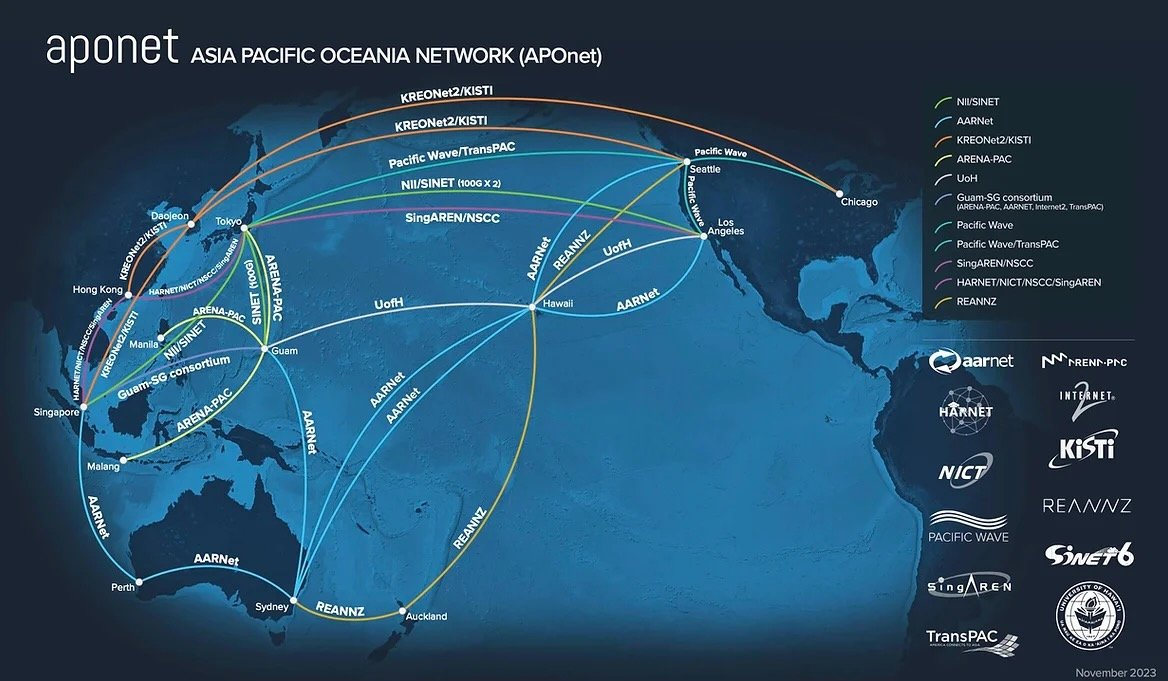
APOnet Asia Pacific Oceania Network Map

Improving Management of Large-Scale Network-Enabled Scientific Workflows

The SciTags initiative is an open international collaboration developing practical networking capabilities for High Energy Physics (HEP) research using National Research and Education Networks (NRENs), including the LHCOPN and LHCOne. SciTags is being developed to provide high-fidelity visibility into how science flows utilize network resources end-to-end, allowing R&E networks to better understand resource utilization and manage large-scale scientific workflows.

The demonstration will showcase the management of internationally distributed resources at a variety of Open Exchange Points over 400 Gbps paths provided by Pacific Wave, StarLight, CANARIE, the Metropolitan Research and Education Network (MREN), and NA-REX.

Dynamic Service Provisioning for Petabyte Data Exchanges

The Global Network Architecture Group (GNA-G) AutoGOLE/SENSE working group will also be presenting several demonstrations and experiments to showcase the global persistent multi-resource infrastructure based on the integration of the AutoGOLE and Software-defined network for End-to-end Networked Science at Exascale (SENSE) functions.

One SC24 demonstration will be showing workflows which include the resources in connected external facilities. Another demonstration will show data movement systems that can interact with the network to optimize their operations.

Integrating Internal and External Distributed Resources

Another set of demonstrations will show the FABRIC (Adaptive Programmable Research Infrastructure for Computer Science and Science Applications) infrastructure in operation.  FABRIC is an international infrastructure that enables cutting-edge experimentation and research at scale in the areas of networking, cybersecurity, distributed computing, storage, virtual reality, 5G, machine learning, and science applications.

The multi-booth FABRIC demonstrations for SC24 will highlight the many methods available for connections to external resources such as edge/site resources and other networks. This includes connections to multiple National Research Platform (NRP) sites and other R&E Networks, showcasing the FABRIC Research Cyberinfrastructure and the ease with which other resources and sites can be integrated.

Visit Pacific Wave at Booth 811

Data rates have grown exponentially since the early days of networked science and show no signs of stopping. These demonstrations and more will be supported by Pacific Wave during Supercomputing 2024 in Atlanta, Georgia, November 18-21, and thanks to them, visitors to the show floor can see how network researchers are preventing the challenges of managing this data from growing at the same rate.

If you’d like to learn more about Pacific Wave or the NREs that Pacific Wave will be supporting at SC24, please visit Booth 811.  You can also find a list of all accepted NREs at the SC24 website.

Super Network Supports Supercomputing 2005

November 17, 2005--Seattle, Washington USA. For the first time ever in a real-world environment, Pacific Northwest Gigapop (PNWGP) and its strategic partners have brought together more than one-half terabit per second (i.e., 500 gigabits per second) of bandwidth in deploying SCinet, the very high performance network built to support Supercomputing 2005 (SC¦05) in Seattle. The network is provisioned through multiple dark fiber strands brought by the University of Washington from the convention center to major telecommunications facilities in the city.

DWDM gear from Ciena, Cisco and Nortel were used to provision more than 50 10Gbps circuits and a native 40Gbps circuit. These circuits were then interconnected to numerous high-bandwidth national backbones, including National LambdaRail, CANARIE, Internet2s Abilene Network and UltraScience Net. International networks worked with these various North American facilities to reach the Seattle venue. In particular, Pacific Rim networks in Japan, Korea, Taiwan and Australia were able to utilize the Pacific Wave distributed peering exchange facility, a joint project between PNWGP and CENIC.

As a direct result of many strategic investments by the University of Washington and the Pacific Northwest Gigapop, Seattle is one of the few places in the world where SC¦05 could benefit from an abundance of first-rate networking resources including metropolitan fiber, carrier-grade telecommunications facilities, a world-class engineering team, and an ever growing concentration of national and international networks, said Steve Corbato, director of network initiatives for Internet2.

This staggering amount of bandwidth, he continued, was deployed seamlessly and provides a truly impressive demonstration of the rapidly evolving suite of network capabilities in support of leading-edge computational science.

Among the many events relying on this bandwidth were massive storage- and data-retrieval tools, the Internet2 Land Speed Record attempts (IPv4 and IPv6), data grids, multipoint real-time, high-definition video from points around the world, super high-definition video, and massive 3D imaging.

Professor Larry Smarr, director of the California Institute for Telecommunications and Information Technology [Calit2], a partnership of the University of California at San Diego and UC Irvine, and principal investigator of the National Science Foundation-funded OptIPuter project offered this observation: The Terabit Era has arrived! This unprecedented achievement of PNWGP and SC¦05 demonstrates that the United States needs to broaden its strategic technology leadership agenda from a focus on faster individual supercomputers to supernetwork-connected resources on a global scale.

Contact:
Jan Eveleth
Managing Director, Pacific Northwest Gigapop
(206) 221 2300
eveleth@pnw-gigapop.net

New Network Speed Record Set

PORTLAND, Oregon, November 15, 1999 -- Seven high technology leaders collaborated at SC99 today to set a number of internet speed records, demonstrating that long-distance gigabit-per-second networking is ready for prime time and that next generation Internet technologies and capabilities are emerging in applications, in end-systems, and in network infrastructure.

To set the stage, at the network infrastructure level, the DARPA-sponsored National Transparent Optical Network (NTON), the University of Washington-led Pacific/Northwest Gigapop (P/NWGP), and Nortel Networks joined forces to deliver 2.4 gigabits per second (Gbps) of packet-over-SONET based standard Internet capacity from the Microsoft Corporation and University of Washington (UW) campuses, through a shared point of presence at the Pacific/Northwest Gigapop in Seattle, to the SC99 exhibition hall in Portland.

Microsoft, the National Computational Science Alliance (Alliance), the University of Washington (UW) and Sony (in support of the ResearchChannel consortium) demonstrated two working, real-time gigabit applications in their coordinated SC99 exhibits. Further, the UW, Microsoft, the Alliance and Sony were able to run these applications concurrently, setting a record of 2 Gbps in aggregate throughput -- by a wide margin clearly the fastest real-time applications ever run over a wide area network.

Earlier this year, the UW and Sony were the first to demonstrate live studio quality, High Definition Television (HDTV) broadcasts over Internet2/Abilene. Today, in another record-breaking effort, they and the partnership successfully transmitted a real-time gigabit HDTV stream of five simultaneous channels of minimally-compressed, studio-quality HDTV over the internet, using industry-standard HDTV video, 'Wintel' computer systems, and networking equipment from leading vendors such as Juniper. Each channel within the overall stream consumed more than 200 million-bits-per-second (Mbps), for a total of well over a billion-bits-per-second in concurrent throughput in a state-of-the-art real-time application.

"More than just showing the stunning quality and immediacy that next generation internet capabilities can bring to the desktop computers, TV's and HDTV's around the world, this demonstration illustrates the feasibility of regularly using Internet transport technology for the real-time delivery of extraordinarily high quality video, virtual reality, tele-medicine, and other imaging streams" said UW Vice President Ron Johnson. He added that the demonstration shows "it is now possible to run distributed broadband applications over high-speed, next generation Internet WANS using hardware and software available in the consumer market". The demo used broadcast and Internet standards, Sony's suite of HDTV gear, off-the-shelf networking equipment, and commodity PCs with Microsoft NT running custom high performance software the UW C&C; group developed using Microsoft Visual Studio and other tools.

By way of comparison, the UW/Sony/ResearchChannel demonstration is the equivalent of the simultaneous transmission of the entire channel lineup of a 150 channel cable TV system, or of 50 channels of broadcast quality HDTV, five feature movies, or interactions among a large number of high-resolution video walls, shared virtual realities, &/or immersive environments. And, it shows that the internet is capable of speeds and quality impossible to achieve with traditional broadcast technologies.

Microsoft and the Alliance and the partners demonstrated that it is now possible to send a gigabit-per-second TCP/IP stream from one Windows 2000 workstation to another over a WAN. Microsoft teamed with the Alliance's NT cluster development team and with the National Laboratory for Applied Network Research (NLANR) to verify that Windows 2000 TCP/IP software performance scales at Gbps rates on long-distance networks. This work demonstrates speed breakthroughs in end-to-end workstation internetworking and shows the capabilities of Windows 2000 TCP/IP.

"Our role in NLANR is to work with application teams to help them harness the capabilities of high performance networks," said Larry Smarr, director of the Alliance and NCSA, the leading-edge site for the Alliance. "Because many of these applications involve Windows workstations, gigabit per second performance of Windows over wide area networks is a capability that impacts the entire high performance computing community."

Jim Allchin, senior vice president of the Platforms Division at Microsoft Corporation, said this demonstration showed that distributed computing over high-speed, long-distance networks is a major part of the future for the Windows OS. "This exhibition shows that Windows 2000 truly is a broadband operating system prepared for the next millennium. Microsoft is thrilled that Windows 2000 is able to display its gigabit-readiness through such a tremendously innovative engineering feat."

Ed Lazowska, Chair of UW's Computer Science & Engineering Department, added that "enabling gigabit networking capabilities on what will eventually be tens of millions of desktops is the first step in unleashing developers worldwide to create the next generation of applications, architectures and content."
Together, these collaborative demonstrations show that the era of gigabit-per-second networking and the next generation of Internet applications and content is at hand.

The joint demonstrations will continue throughout the rest of SC99. For demonstration times, visit the Alliance research booth (R300) or the joint demo booth (RE602), or to see the demonstrations go to the UW research booth (RE602) where the suite of coordinated demos are being run.

About Microsoft

Founded in 1975, Microsoft (Nasdaq "MSFT") is the worldwide leader in software for personal and business computing. The company offers a wide range of products and services designed to empower people through great software - any time, any place and on any device. Microsoft and Windows are either registered trademarks or trademarks of Microsoft Corporation in the United States and/or other countries. Other product and company names herein may be trademarks of their respective owners.

About the Alliance/NCSA

The National Computational Science Alliance is a partnership to prototype an advanced computational infrastructure for the 21st century and includes more than 50 academic, government and industry research partners from across the United States. The Alliance is one of two partnerships funded by the National Science Foundation's Partnerships for Advanced Computational Infrastructure (PACI) program, and receives cost-sharing at partner institutions. NSF also supports the National Partnership for Advanced Computational Infrastructure (NPACI), led by the San Diego Supercomputer Center. The National Center for Supercomputing Applications is the leading-edge site for the Alliance. NCSA is a leader in the development and deployment of cutting-edge high-performance computing, networking, and information technologies. The National Science Foundation, the state of Illinois, the University of Illinois, industrial partners, and other federal agencies fund NCSA. For more information, see www.ncsa.uiuc.edu

About The University of Washington (UW)

The University of Washington is one of the world's leading research institutions. While the UW has great strength in a comprehensive array of disciplines and professions in technical and non-technical realms, it is especially well known for its world class programs in computer science and the health sciences, and for its long and continuing role in the evolution of the Internet, Internet messaging technologies, software agents, and digital convergence in new media. For more information, see www.washington.edu/hdtv/sc99

About ResearchChannel

ResearchChannel is a consortium of many of the world's leading research institutions that is dedicated to providing greater, much more timely, and far broader access to progress in, and the findings and outcomes of university, government and corporate R&D; efforts. In partnership with University Corporation for Advanced Internet Development (UCAID), ResearchChannel also conducts core Internet2 (www.internet2.edu) broadcast and high speed demand video initiatives. For more information, see www.washington.edu/researchtv

About Sony

Sony Electronics is the premier provider of leading-edge digital video technology for broadcast, production and HDTV, as well as exceptional quality consumer electronics, computer, and display products. The University of Washington and Sony have partnered successfully to pioneer HDTV over Internet capabilities. For more information, see www.sony.com/professional

About the Pacific/Northwest Gigapop (P/NWGP)

The Pacific/Northwest Gigapop is the Northwest's Next Generation Internet applications cooperative, testbed, and point of presence. P/NWGP connects universities as well as research institutions and R&D; enterprises throughout Washington, Alaska, Montana, Idaho and Oregon, to one another, to the next generation Internet backbones (including vBNS, Internet2/Abilene and now NTON), to federal research networks, and to super-high-performance commodity internets. For more information, see www.pnw-gigapop.net

About National Transparent Optical Network (NTON)

The National Transparent Optical Network links government, research and private sector labs and provides the ability to interface with most of the broadband research networks in the U.S. NTON is a 2000 km 10-20 Gbs Wavelength Division Multiplexed network deployed using in-place commercial fiber. NTON provides direct access to nearly all of the major universities on the West Coast at data rates up to, and potentially beyond, 2.5 Gbs. For more information, see www.ntonc.org

About National Laboratory for Applied Network Research (NLANR)

The National Laboratory for Applied Network Research is an NSF-supported collaboration to provide technical, engineering and traffic analysis support for NSF's High Performance Connections sites and the broad vBNS user community. NLANR major activities are performed by three teams: a distributed applications support team based at the University of Illinois' National Center for Supercomputing Applications; a measurement and analysis team based at the San Diego Supercomputer Center; and a networking engineering support team based at the Pittsburgh Supercomputing Center.

Contacts
Jennifer Todd
Waggener Edstrom/Microsoft
jtodd@wagged.com
425-637-9097

David Richardson
University of Washington
drr@u.washington.edu
206-543-2876

Karen Green
NCSA/Alliance
kareng@ncsa.uiuc.edu
217-265-0748

Susan Brandt
ResearchChannel
sbrandt@u.washington.edu
212-414-4672

Lisa Young
Sony Electronics
lisa.young@am.sony.com
408-955-5683

Jacqueline Brown
P/NWGP
jbrown@cac.washington.edu
206-685-6238