News

News & Events

Posts tagged AARNet
AARNet and Southern Cross Cable Network boost trans-Pacific research network to 100G

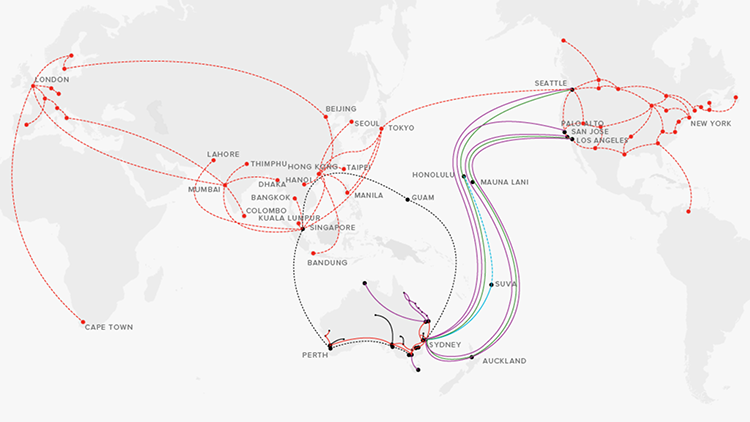
The 100 Gigabit per second (Gbps) upgrade to the Southern Cross Trans-Pacific Optical Research Testbed (SXTransPORT) dual submarine optical fibre links connecting Sydney to North America is complete.

The upgrade boosts bandwidth on both SXTransPORT links from 40 Gbps to 100 Gbps to accommodate the year-on-year growth of research and education traffic over the AARNet network. This traffic growth is driven by data-intensive science.

Networking to support data-intensive science

AARNet CEO Chris Hancock says this network infrastructure linking Australia to the United States and the global network of research and education networks is fundamental to Australia’s research infrastructure, underpinning much of Australia’s research efforts and innovation agenda.

“With research today increasingly collaborative, global and data-intensive, increasing the bandwidth of the SXTransPORT network ensures Australia continues to make significant contributions to global research endeavours, such as the Large Hadron Collider, the development of the Square Kilometre Array, the World Climate Research Program and important advances in the health and medical research sector,” he said.

AARNet’s long-term partnership with Southern Cross, together with funding from the United States National Science Foundation to the University of Hawaii, the Commonwealth and other entities, has evolved into a truly Pacific activity, integrating the New Zealand research network, REANNZ, and connecting one of the world’s most important international astronomy sites, Mauna Kea (Hawaii Island), as well as the international observatories on Haleakala (Maui), operated by the University of Hawaii.

Connecting isolated Pacific Island countries

The partnership has also secured broadband connectivity for several isolated Pacific Island countries, and notably for the University of the South Pacific campuses in Fiji, Tonga and the Marshall Islands. The South Pacific is a key region for observing climate changes, as well as oceanography, biodiversity and coral reef health. Connecting the Pacific Islands provides an opportunity to engage Pacific Islanders in a wide range of scientific and research initiatives in these fields of critical concern to their communities.

University of Hawaii President and CEO, David Lassner, a driving force behind United States funding and the collaborative work to connect the Pacific Islands, says the 100G upgrade to the network is another great milestone for research and education in the Pacific region.

“Working closely with colleagues at AARNet, Southern Cross and other collaborators, with the support of the National Science Foundation, has enabled Hawaii to participate in the continuing transformation of research and education through advanced broadband connectivity. Complex research that provides insights on the major challenges and opportunities the world faces must be increasingly interdisciplinary and international ” he said “and advanced networks like SXTransPORT are fundamental infrastructure for large-scale collaboration and enablement of the cyberinfrastructure that supports essential big data techniques.”

An enduring higher ed/industry partnership

Since 2003, Southern Cross Cable Network has provided the SXTransPORT in partnership with AARNet exclusively for not-for-profit research and education use. This has opened up opportunities for global collaboration that were previously unavailable to institutions in the Pacific region.

“Southern Cross is proud to be a long-term supporter of scientific and research endeavours through its partnership with AARNet. By extending the network to connect to REANNZ and Pacific Island Countries, the SXTransPORT project is an example of a truly exciting initiative in which all partners have worked together collaboratively to bring about great achievements for the region,” says Anthony Briscoe, President and CEO, Southern Cross Cable Network.

–ENDS–

About AARNet

AARNet Pty Ltd (APL) is the not for profit company that operates Australia’s Academic and Research Network (AARNet). The shareholders are 38 Australian universities and the CSIRO.

For more than 25 years, AARNet has provided ultra-high-quality regional, national and international broadband services to the Australian education and research sector, including universities, health and other research organisations, schools, vocational training providers and cultural institutions. By globally interconnecting like-minded collaborators, big data, innovative software tools and resources such as high performance computing, AARNet plays a vital role enabling the National Innovation and Science Agenda.

AARNet also provides a range of value-added network and collaboration services to support teaching, learning and research.

For more information, please visit AARNet at: www.aarnet.edu.au

About Southern Cross Cable Network

Southern Cross Cable Network provides fast, direct, and secure international bandwidth from Australia, New Zealand and Hawaii to the heart of the Internet in the USA.

The Southern Cross Cable Network comprises two submarine communications cables which were first commissioned in November 2000 and January 2001 at a cost of USD1.3 billion. They provide Australasian broadband users with international connections to the US West coast where global Internet hubs are located.  In 2001, total installed capacity was 80 Gbps, which has subsequently risen to 5.4Tbs of installed capacity today.

Latest technology trials have confirmed Southern Cross potential capacity of 14Tbs and beyond. The Southern Cross Cable Network is owned by Spark NZ (50%), Singtel-Optus (40%) and Verizon Business (10%).

Southern Cross Cable Network has offices in Bermuda, Sydney, Auckland and Wellington.

For more information, visit Southern Cross at: www.southerncrosscables.com

Media Contacts:

AARNet

Jane Gifford, Media & Communications Manager media@aarnet.edu.au; +61 458 700213

Southern Cross Cable Network

Rosemay Foot, Media Manager rosemay.foot@sccn.co.nz; +64 4 496 3250

https://news.aarnet.edu.au/aarnet-and-southern-cross-cable-network-boost-trans-pacific-research-network-to-100g/

AARNet launches SDN innovation platform for researchers

AARNet, Australia’s Academic and Research Network, today announced the launch of the Australia Wide-Area SDN Testbed, an innovation platform for developing high-speed technologies, established in collaboration with nine universities and CSIRO Data61. The announcement was made during the Open Networking Foundation SDN Down Under event in Sydney.

Software Defined Networking (SDN) is an emerging technology with the potential to revolutionise the way networks are provisioned and managed. SDN offers solutions for improving network flexibility and reducing costs via software-based management and control.

A real-world research environment

“The Testbed is a real-world research network environment, a simulation of the Internet that we’ve put in place to make it easier for researchers in the fields of computer science, engineering and mathematics to test, prototype and validate advanced networking concepts in the SDN arena and accelerate the development of high-speed networking. Developing and supporting initiatives to explore what the future network might look like has been a focus of AARNet’s work since its early days of pioneering the Internet in Australia,” says AARNet’s CEO Chris Hancock.

David Wilde, AARNet’s Chief Technology Officer says access to a wide-area SDN testbed provides researchers with new opportunities to exploit the potential of SDN.

“We know SDN works in single domain environments, like the campus and data centre, but little research has been undertaken to validate whether the technology works across multiple domains with different administrators, such as telco carriers and enterprises.”

A consortium of researchers from CSIRO Data61 and nine universities, led by the University of New South Wales (UNSW), secured LIEF (Linkage Infrastructure, Equipment and Facilities) grant funding from the Australian Research Council to deploy SDN equipment within each of their labs.

The other eight consortium members are University of Technology Sydney, Macquarie University, University of Adelaide, RMIT, Swinburne, University of Queensland, University of Wollongong and Australian National University.

These sites are being interconnected by AARNet to create a national wide-area SDN testbed environment with the ability to peer internationally with testbeds in the USA, Europe and elsewhere.

Professor Vijay Sivaraman of the UNSW School of Electrical Engineering and Telecommunications and a driving force behind the project says, “SDN is fairly new and disruptive, but a barrier to uptake for organisations that could benefit from it, such as enterprises and carriers, is that the technology hasn’t been validated sufficiently. The main objective for establishing this Testbed is to demonstrate to industry that the technology is not just a great idea on paper, but something that will work in practice, and show how it works under real conditions.”

SDN teases apart the data forwarding function of a piece of network equipment from its path calculation function, taking advantage of commodity network hardware for the former and inexpensive virtualised compute for the latter to deliver network flexibility.

Testbed infrastructure

Based on open standards, the Testbed infrastructure consists of a core of four interconnected NoviFlow OpenFlow-enabled switches at AARNet backbone sites in Sydney, Melbourne, Perth and Seattle controlled by virtual machines (VMs) in Sydney and Melbourne.

The four switches talk to the VM OpenFlow controllers, which are running ONOS software, developed by Open Networking Lab, and appear as a single distributed router – spread across 16,000km. Connectors from this AARNet core run out to SDN equipment (a similar set up of switches and servers) installed in the labs at the participating universities and CSIRO Data61.

With the AARNet core acting as a network exchange interconnecting the university SDN network domains, the setup simulates the Internet.

The Seattle presence enables AARNet to interconnect the testbed with similar testbeds operated by Internet2 and ESnet research networks in the United States, as well as with the global OpenFlow network facility recently deployed by ON.LAB, boosting opportunities for Australian researchers to run experiments with their US-based counterparts.

“Connecting to Seattle enables us to examine network behaviour at genuine intercontinental scale, and will enable us to explore how and if SDN works across progressively larger geographical areas. Australia’s international connectivity is very expensive – a potential real world application of SDN is to examine ways we can make more efficient use of our international links, leading to cost savings,” says Wilde.

He is also interested in exploring the dynamic provisioning of multi-layer services for better integration of network compute and storage nationally and globally.

“This is about building a network that can more intelligently shift connect compute resources to data storage, or move data without taking congestion paths,” he explains.

Professor Sivaraman says a primary research focus for UNSW is quality of service.

“At the campus level, we’re interested in how we can improve the user experience online by using SDN technology. We want to be able to distinguish between video content, for example, and a large data transfer from a research lab so that we can prioritize traffic,” says Professor Sivaraman.

Craig Russell, Principal Research Engineer of CSIRO’s Data61 innovation group, and another driving force behind the project, says the ideal outcome from research in this area is a wider acceptance that SDN is viable so that commercial organisations can see that the technology can solve some of the problems they face.

“The Testbed can also be utilized as an incubator for startups, an environment for stimulating ideas and developing proof of concepts, and nurturing projects that ultimately end up as products in the marketplace,” says Russell.


Media Contact

Jane Gifford

+61 2 9779 6960

media@aarnet.edu.au

https://news.aarnet.edu.au/aarnet-launches-sdn-innovation-platform-for-researchers/

Australia-US partnership powers trans-Pacific science and research networking

A long-standing Australia-United States (US) joint venture to facilitate research and education (R&E) network capacity across the Pacific Ocean was celebrated on 28 April 2015 at a special event held at the Embassy of Australia in Washington DC.

AARNet provides the network infrastructure connecting Australia to the US West Coast in partnership withSouthern Cross Cable Network (SCCN). With the very generous support of SCCN, AARNet is upgrading the submarine optical fibre links known as SXTransPORT to 100 Gbps by the end of 2016. Building on a series of investments, the US National Science Foundation (NSF) this week announced funding for upgrading the US side of the infrastructure interconnecting AARNet to the US research networks.

Technology leaders from AARNet, NSF, REANNZ, Internet2, Pacific Wave and the University of Hawaii were among the guests celebrating the ongoing international collaborative effort that has contributed to the development of the trans-Pacific research network infrastructure over many years.

AARNet CEO Chris Hancock said this investment continues the strong relationship between the NSF and Australia for interconnecting AARNet to the US R&E community that dates back to the early 1990s. The relationship has been characterized by aligned and supportive network investments on both sides of the Pacific.

“AARNet’s upgrades to the SCCN and SXTransPORT links have been critical for accommodating the growth of international traffic over the network, largely driven by data-intensive science. Developing international R&E network capacity between Australia and the US has also evolved into a truly Pacific activity, with AARNet recently connecting REANNZ, the New Zealand NREN, as well as supporting connectivity into Pacific Island countries such as Fiji, Tonga and the Marshall Islands,” said Hancock.

Jim Kurose, Assistant Director of NSF’s Computer and Information Science and Engineering Directorate said the award builds on successful, proven prior partnerships between the Australian Government and the NSF.

“The funding will provide a critical network upgrade to the US end to accommodate today’s data-intensive science and to drive scientific discovery in many areas, including astronomy, oceanography, and high-energy physics,” he said.

The forthcoming upgrade will support US connectivity that passes through Hawaii to connect one of the world’s most important international astronomy sites, Mauna Kea (Hawaii Island), as well as the international observatories on Haleakala (Maui).

Australia’s Ambassador to the USA Kim Beazley acknowledged the vital role globally interconnected research network infrastructure plays.

“The Embassy of Australia is pleased to celebrate the continued Australia-US partnership in critical research infrastructure and the advanced Pacific R&E network connection. The project builds on a rich history of research collaboration between our two nations, and will greatly expand opportunities to work together in areas of mutual interest, including astronomy, global climate issues, biodiversity, and coral reef study, and medicine,” he said.

http://news.aarnet.edu.au/australia-us-partnership-powers-trans-pacific-science-and-research-networking/

Pacific Wave Announces Diverse 40G TransPacific Capacity to Australia and New Zealand

Upgrade to Major US West Coast Peering Exchange for Research and Education Enhances Worldwide Ultra-High-Performance Networked Collaboration

Pacific Wave today announced the completion of a second 40-Gigabit per second (Gb/s) connection from the US West Coast to Australia and New Zealand.  Crossing the Pacific Ocean from Los Angeles through the Big Island of Hawaii and on to Australia, this ultra-high-performance network link complements an existing 40 Gb/s link from Seattle through Oahu to Australia.

Both links provide increased performance and robustness to the Pacific Wave distributed international peering exchange, which is the chief means by which the world's advanced research and education networks cross the Pacific Ocean and a crucial part of the global advanced networking infrastructure.  In this capacity, Pacific Wave enables cutting-edge activity in all realms of data-intensive science, including cancer treatment, climate research, digital media, genomics, oceanography, seismography, software-defined networking, space science, and more.

A joint project between the Corporation for Education Network Initiatives in California (CENIC) and the Pacific Northwest Gigapop (PNWGP) with support from the University of Southern California and the University of Washington, Pacific Wave is a state-of-the-art international peering exchange designed to serve research and education networks throughout the Pacific Rim and beyond and features connection points at three US West Coast locations: the San Francisco Bay Area, Los Angeles, and Seattle.  

"Global innovation, particularly in the data-intensive sciences where our most pressing modern challenges lie, is no longer possible without global networking," observes Louis Fox, President and CEO of CENIC.  "Maintaining our shared advanced network infrastructure at the highest possible level is critical if we are to overcome the challenges we confront in climate change, medicine, and economics, to name but a few areas."

"Shared infrastructure improvements like this -- and others yet to come -- are probably among the most effective investments that society can make nowdays, given the positive impact they can create for global communities and for our planet," Fox added.

"It's important to note that upgrades like this are not an endpoint in themselves but a step toward the future," states PNWGP's Executive Director Amy Philipson.  "Increased bandwidth invariably brings increased demand for bandwidth, which is why Pacific Wave's planned connectivity upgrades include 100 Gbps connectivity as well -- and I'm sure it won't end there."  Adds Philipson, "It's also important to note that this will not only benefit innovation in Australia and New Zealand but around the world as well.  Some of the most significant institutions and data-intensive scientific instrumentation in the world is located there, which means that researchers around the globe will also benefit from greatly improved connectivity to their colleagues two nations."

"This upgrade significantly improves global access to the unparalleled collection of international astronomical observatories in Hawaii," said University of Hawaii President David Lassner, who also serves as principal investigator for the NSF International Research Network Connections (IRNC) project that supported the US costs of the upgrade.  "Current instruments already generate terabytes of data every 24 hours, and next generation projects like the Thirty Meter Telescope on Mauna Kea and NSF-supported Daniel K. Inouye Solar Telescope on Haleakala will challenge our international research networks even more.  So it was critical that we built into this upgrade our plans to move to 100 Gbps in 2016."

This announcement also comes on the heels of an announcement by the Australian advanced network AARNet of their new partnership with New Zealand advanced network REANNZ and Southern Cross Cable Networks to provide New Zealand scientists and researchers with access to ultra high-speed international connectivity as well as the general Internet.  The partnership means that New Zealand scientists and researchers will, for the first time, have capacity for big-data transport between New Zealand and the rest of the world.

"As long time participants in Pacific Wave, REANNZ has benefited greatly from the distributed multi-city and multi-network exchange model that provides convenient 'one-stop' high performance connectivity to the US scientific community," says Steve Cotter, CEO of REANNZ.  "We look forward to continued collaboration as we plan to scale our networks to 100G and deploy emerging technologies like software defined networking."

"We're pleased to be contributing to the expansion of vital global research network infrastructure," adds AARNet CEO Chris Hancock.  "Built in partnership with Southern Cross Cable Networks, this second high-speed AARNet link across the Pacific adds capacity, diversity and redundancy to our network, further bolstering our international connectivity to ensure Australia's, and New Zealand's, participation in major international scientific research collaborations."

More information including network maps and a full list of participants can be found at www.pacificwave.net.

* TransLight/Pacific Wave is funded by NSF Award No. 0962931.

Jonah KeoughPacific Wave, AARNet
International Collaboration results in successful transfer of Huygens space probe data from Australian telescopes to the Netherlands

AARNet News - 18 January 2005 - Nine organisations from four countries, with AARNet, Australia's Academic & Research Network, providing a coordinating role, were involved in the successful electronic transfer to the Netherlands of data collected by Australian telescopes from the Huygens space probe as it plunged through the clouds of Titan on 14 January 2005.

Titan is the largest of Saturn's 33 moons and the second-largest moon in our Solar System, with a diameter about one-and-a-half times that of our Moon. The surface of Titan is unlike anything encountered before. It has a thick atmosphere, and is thought to harbour organic compounds that may offer clues about the beginning of life on Earth.

The main objective of the Huygens mission was to drop the probe into Titan, to measure various properties of Titan's atmosphere and surface. A global international network of radio telescopes was also taking part in direct tracking of the transmission from the Huygens probe. Those involved included the Australian radio telescopes of CSIRO, based near Narrabri, Coonabarabran and Parkes in NSW; those of University of Tasmania, based in Hobart and Ceduna, South Australia, and 12 others based in China, Japan, and the United States.

Using a technique known as Very Long Baseline Interferometry (VLBI), this network of 17 radio telescopes collected data to pinpoint the European Space Agency's Huygens probe during its descent through Titan's atmosphere. The data from two Australian telescopes, Parkes and Mopra, were the first to be received for processing by the Joint Institute for VLBI in Europe (JIVE) in the Netherlands and used for quick end-to-end
diagnostics of the Huygens VLBI tracking performance prior to the data from all the telescopes being processed to determine the position of the probe to within a kilometre.

Data from the CSIRO telescopes were flown to the Australia Telescope National Facility (www.atnf.csiro.au). This data was then transferred to AARNet (www.aarnet.edu.au) in Sydney across a dedicated Gigabit Ethernet path on the CeNTIE network (www.centie.net) set up for this purpose. From there the data was sent to the Pacific North West GigaPoP's Pacific Wave facility in Seattle (http://www.pacificwave.net)
across the northern 10Gbps leg of SX TransPORT, a joint initiative between Southern Cross Cable Network and AARNet (www.aarnet.edu.au/news/sxtransport.html).

AARNet's router in Seattle was then connected to an optical switch of CANARIE, Canada's advanced Internet development organisation (www.canarie.ca) and a User Controlled LightPath (UCLP) was built from Seattle to JIVE using CANARIE's infrastructure to the MANLAN facility in New York; the Internet Educational Equal Access Foundation's trans-Atlantic capacity (www.ieeaf.org) to SURFnet in Amsterdam
(www.surfnet.nl); and a SURFnet Gigabit Ethernet path to JIVE at Dwingeloo (www.jive.nl).

In the first transfer, two 13 minute scans from Mopra (Coonabarabran) and "the Dish" (Parkes) were transferred at a data rate of about 450Mbps (equivalent to recording a full CD every 12 seconds) to JIVE where they were reformatted and 'correlated' to show perfect 'fringes' meaning that the observations had been successful. This news was applauded at the major European Space Agency press conference at the Mission Control Center on 15 January 2005, the day after the touch-down on Titan.

AARNet is working with members of the Astronomy community in Australia to provide gigabit capacity directly to the telescopes, which of necessity need to be in remote locations. AARNet is also working with the University of Hawaii, Southern Cross Cable Network, and other members of the international astronomy community to connect the
telescope complex at Mauna Kea in Hawaii to form the basis of a global astronomy initiative.

Amy PhilipsonAARNet
SXTransPORT extended to Hawaii, used in PTC demonstrations

AARNet News - 18 January 2005 - from David Lassner, CIO, University of Hawaii

The University of Hawaii has demonstrated Hawaii's first 10Gbps (billions of bit per second) connection outside the State. The new link, which connects Hawaii to Australia and the U.S. mainland, is part of the SX TransPORT project, a partnership between the Southern Cross Cable Network (SCCN) and AARNet, Australia's Academic and Research Network. 

On January 10 the University of Hawaii first used the new connection for a remote microscopy demonstration between the Lariat project meeting in Honolulu and the National Center for Microscopy and Imaging Research (NCMIR) at the University of California at San Diego. Between January 17 and 19, the link is being demonstrated for a variety of applications at the Pacific Telecommunications Council (PTC) meeting at the Hilton Hawaii Village in Waikiki. 

David Lassner, University of Hawaii Chief Information Officer and Chair of the PTC 2005 conference thanked the many partners who helped bring this multi-year initiative to fruition. "Through SX TransPORT, our colleagues at AARNet and Southern Cross have provided the foundation for Hawaii to begin to participate in the continuing transformation of research and education through advanced broadband connectivity. Our collaborators in the Pacific Northwest and California are making it
possible for Hawaii and Australia to leverage this capability by assisting in acquiring the additional resources and support to connect SX TransPORT to US-based advanced networks and exchange points that reach the rest of the world. 

Lariat is the physical networking project being conducted by the Pacific NorthWest Gigapop as part of a $10m NIH award to Montana State University to enhance the capability for biomedical research in Alaska, Idaho, Wyoming, Nevada and Hawaii. The remote microscopy demonstration on January 10 permitted participants at the Lariat meeting at the East-West Center on the University of Hawaii at Manoa campus to view in real-time the images from a multi-million dollar laser scanning electron microscope at the NCMIR in San Diego. This demonstration used over 500Mbps (millions of bits per second) to send the uncompressed data from San Diego to Honolulu. The Lariat meeting also included remote video participants from Canberra, Australia and NIH in Maryland.

The new link is also being shown at PTC 2005, the 27th annual PTC conference which is the longest-running annual telecommunications meeting for the Pacific hemisphere. PTC attracted over 900 delegates from more than 40 countries as well as several thousand additional " networkers" who do business alongside the PTC meeting. Advanced applications of broadband are being highlighted in a series of
demonstrations in the Broadband Playground and Exhibit Hall. 

The Communications Research Centre (CRC) of Industry Canada, which coordinated the entire Broadband Playground at PTC 2005, has arranged a number of innovative demonstrations of broadband technology in E-Learning using Canada's advanced CA*net 4 network which interconnects with SX TransPORT via Pacific Wave in Seattle. These demonstrations include a real-time demonstration of remote piano control, high-quality real-time audio and video for coaching music students, multiparty
collaborative virtual reality, and a sharing of indigenous culture and educational performance events.

The ResearchChannel, based at the University of Washington, is showing interactive High Definition Television (HDTV) over the Internet at speeds of 270Mbps per stream. One of the HDTV programs being shown is PBS Hawaii's "First Light" documentary about Mauna Kea, which has been digitized for playback in Honolulu from a server in Seattle.

Videoconferencing with AARNet in Canberra is being shown using uncompressed and inexpensive but high-quality consumer-grade DV-Cam technology and desktop PCs. 

Another HDTV-over-IP technology is being shown by the Japanese National Institute of Information and Communications Technology (NICT), which operates the Japan's JGN2 advanced network. In addition to transmitting HDTV among Alaska, Honolulu and Osaka, NICT also brought their popular wireless Internet-based car racing technology that permits drivers in Alaska, Japan and Hawaii to compete against each other in real-time using a physical race-track at PTC in Honolulu. 

Internet2 is showing the new "DVGuide," which shows the digital video programming available on global research and education networks from around the world. 

In addition to the 10Gbps trans-pacific fiber optic lightwave provided for SX TransPORT by SCCN to AARNet, a number of other components have been required to realize this level of advanced broadband technology. The Lariat project provided support for the high-speed connection from the SCCN landing in Oregon to the Pacific Wave optical
exchange point in Seattle. 

A new NSF award for international networking to the University of Southern California will assist in extending SX TransPORT from Australia to the Big Island and on to California using a second 10Gbps SX TransPORT lightwave on the southern route of SCCN.

Pacific LightNet Incorporated (PLNI) provided the University of Hawaii with the 10Gbps lightwaves on Oahu to connect between the SCCN landing point at Kahe Point and the UH-Manoa campus. Pacific Wireless Corporation and fSONA provided the free space optics link to connect between UH Manoa and the Hilton Hawaiian Village for the PTC
demonstrations.

The SX TransPORT network is currently in "pre-production" for these and other demonstrations. Work is planned on the production configuration to support education and research after the conclusion of PTC.

See the following links for additional information:

University of Hawaii - http://www.hawaii.edu
SX TransPORT - www.aarnet.edu.au/news/sxtransport.pdf
AARNet - http://www.aarnet.edu.au/
Southern Cross Cable Network - http://www.southerncrosscables.com/
Lariat - http://lariat-west.org/
PTC 2005 - http://www.ptc.org/ptc05
Pacific Wave - http://www.pacificwave.net/
NCMIR - http://ncmir.ucsd.edu/
CRC - http://www.crc.ca/en/html/crc/home/home
CA*net 4 -http://www.canarie.ca/canet4/
ResearchChannel - http://www.researchchannel.org
NICT - http://www.nict.go.jp/overview/index.html
JGN2 -http://www.jgn.nict.go.jp/e/02-about/02-1/
Internet2 - http://www.internet2.edu
PLNI - http://www.plni.net/
PWC - http://www.pwchi.com/
fSONA - http://www.pwchi.com/

Working photos available at:
http://laphroaig.uhnet.net/~whinery/PTC2005/PTC2005-001/

First multi-gigabit interactive video transmission between Australia and the US

PITTSBURG, PENNSYLVANIA, USA, November 8, 2004 and CANBERRA, AUSTRALIA, November 9 2004 - AARNet (Australia's Academic and Research Network) and ResearchChannel today demonstrated the first high definition uncompressed interactive video interaction across the Pacific at 1.4 gigabits per second in each direction.

The demonstration took advantage of recent massive increases in bandwidth capabilities from Australia to the continental United States on network capacity provided by Southern Cross Cable Networks, to deliver truly remarkable quality video interaction between AARNet's head office in Canberra and the exhibition floor of the Supercomputing Conference SC2004 in Pittsburg, Pennsylvania.

The partnership between ResearchChannel, AARNet, and the University of Washington provided applications that spurred the development of high speed networks and enabled data transfers previously unavailable between the two continents.

The unprecedented high-quality, low-latency interactive video is the first use of the Southern Cross Trans-Pacific Optical Research Testbed (or SXTransPORT), a dual 10Gbps trans-Pacific initiative of Southern Cross Cable Networks and AARNet and acquired with assistance from the Australian Government. The network path also involved the Pacific Northwest Gigapop and the US National LambdaRail (NLR) 10 gigabit network fabric. The network path also makes use of US National Institutes of Health-funded networks through the University of Hawaii. Future expansion of the network is planned to offer these and additional resources to other continents, and bring scientists and researchers together by exploiting new Internet technologies.

Using two Intel PCI-Xpress computers and AJA Video Systems' Xena-HD HDSDI capture cards, the demonstration is the first to show High Definition interactive systems over Windows XP platforms, providing researchers, medical practitioners and scientists worldwide with new interactive video capabilities.

"This demonstration is the first highly visual culmination of the recent initiatives between AARNet's international developments arm and Southern Cross at the infrastructure level and with our colleagues at the University of Washington at the infrastructure, technology and applications levels," said AARNet's CEO, Chris Hancock.

Dr Mike Sargent, who chairs the Australian Research and Education Network initiative, participated for part of the opening session and engaged with Professor John O'Callaghan, CEO of the Australian Partnership for Advanced Computing, and other participants in Pittsburg for the Supercomputing Global 2004 conference.

"This is a great demonstrator of the benefit of strategic investment of Australian Government funds in helping put the network infrastructure in place to support these innovative applications" said Dr Sargent.

"The video quality presented at the exhibition floor of the SC2004 conference in Pittsburg from Australia is exceptional" said Professor O'Callaghan.

Demonstrations will continue through the rest of this week, though in Australian time these sessions are from 2am to 10am of the mornings of Tuesday, Wednesday and Thursday, and from 2am until 8am on Friday.

------------------------------------------------------------

Background information

About AARNet
Australia's Academic and Research Network (AARNet) provides high capacity, leading edge Internet services for the tertiary education and research sector communities, and their research partners. For more information about AARNet, please visit http://www.aarnet.edu.au.

About Research Channel
ResearchChannel is a non-profit organisation dedicated to creating a voice for research through video and Internet channels. For more information about ResearchChannel, please visit the web site at www.researchchannel.org.

About Southern Cross Cable Network
The Southern Cross Cable Network provides the fastest, most direct, and most secure international bandwidth from Australia, New Zealand and Hawaii, to the heart of the Internet in the United States. For more information about SCCN, please visit their web site at http://www.southerncrosscables.com/.

About SXTransPORT
The Southern Cross Trans-Pacific Optical Research Testbed is an initiative of Southern Cross Cable Networks and AARNet, supported by the Australian Government, that provides dual 10Gbps circuits between Australia, Hawaii and the US west coast. For more information about SXTransPORT, please visit http://www.aarnet.edu.au/news/sxtransport.pdf

About the University of Washington
Founded in 1861, the University of Washington is a public research university with over 41,000 students on campuses in Seattle, Tacoma and Bothell, Wash. For more information about the University of Washington, please visit the web site at http://www.washington.edu.

About Intel
Intel Corporation is an industry leader in supplying the computing and communications industries with the "ingredients" of computers, servers and networking and communications products. For more information about Intel Corporation, please visit their web site at http://www.intel.com.

About AJA Video
AJA Video is a leading manufacturer of digital video solutions for the professional broadcast and post-production markets. For more information about AJA, please visit their web site at http://www.aja.com.

About National LambdaRail
National LambdaRail, Inc.'s (NLR) fundamental mission is to provide a network infrastructure for new forms and methods for research in science, engineering, health care and education, as well as for research and development of new Internet technologies, protocols, applications and services. For more information about NLR, please visit their web site at http://www.nlr.net.

About Northwest Gigapop
Pacific Northwest Gigapop is a state-of-the-art, advanced high-speed Internet service provider based in Seattle, Wash., and a next-generation network interconnector for Pacific Rim research, education and development networks. For more information visit
http://www.pnw-gigapop.net.

Pacific Northwest Gigapop Introduces Pacific Wave International Peering Services

SEATTLE, WASHINGTON, USA - October 1, 2001 - The Pacific Northwest Gigapop has expanded and renamed its regional peering service, formerly called Seattle-Network-to-Network Access Point, or SNNAP. The expanded peering services will now be offered under the name Pacific Wave. Pacific Wave will continue to include peering services for entities within the Pacific Northwest, but has expanded its offering to include research and education networks from throughout the Pacific Rim and beyond.

"The Pacific Northwest Gigapop was established in part to support state of the art networking infrastructure that would unite researchers and educators in the Internet2 effort. The Pacific Wave service extends this mission to entities beyond the United States by providing a convenient, cost-effective peering service," said Ron Johnson, Vice President and Vice Provost of the University of Washington. (The University of Washington is the founder of the Pacific Northwest Gigapop.)

"When looking at the Pacific Wave service, AARNet (Australian Academic & Research Network) recognized a desirable congruence of an easily accessible carrier-class facility near the western U.S. coast, high bandwidth peering access to the Internet2 Abilene network, as well as access to several U.S. Federal networks and the Canadian research and education network, CANet*3. In addition, the peering infrastructure will support our multicast needs and enable us to more efficiently stream media between Australia and our peering partners," said George McLaughlin Executive Director of AARNET.

"We are pleased that Pacific Wave is offering an effective option for research and education networks around the Pacific Rim to connect to members of the Internet2 community in the United States and beyond," said Heather Boyles, director of international relations for Internet2. "Pacific Wave is yet another example of how Internet2 member institutions are making important contributions to the rest of the Internet2 membership by facilitating high performance international connectivity with research and education institutions around the world."

Pacific Wave looks forward to the addition of two more Pacific Rim research and education networks in the next few weeks.

In addition to those already mentioned, other peering partners of Pacific Wave include Energy Sciences Network (ESNet), Defense and Research Engineering Network (DREN), CANet*3, Microsoft Corporation, and AT&T; @Home.


About Pacific Wave
Pacific Wave is a peering service of the Pacific Northwest Gigapop. Located in an internationally-recognized carrier facility in downtown Seattle, Washington, USA, Pacific Wave supports peering among international and national networks as well as among organizations throughout the Pacific Northwest. Participants connect to the Pacific Wave peering switches at either dual gigabit ethernet or dual fast ethernet. At this time, the redundant Pacific Wave switches have a switching capacity of 128Gbps. While each Pacific Wave participant will peer with the Pacific Northwest Gigapop and its affiliated networks, all other bilateral peerings through Pacific Wave are self-selected and implemented by the peering participants directly.


About Pacific Northwest Gigapop (PNWGP)
Pacific Northwest Gigapop is the Northwest's Next Generation Internet, Internet2/Abilene applications cooperative, testbed, and point of presence. PNWGP connects together high-performance international and federal research networks with universities, research organizations, and leading-edge R&D; and new-media enterprises throughout Washington, Alaska, Idaho, Montana, Oregon, Canada, and Australia.


About the University of Washington
The University of Washington is one of the world's top research universities. Perennially among the top three American institutions in peer-reviewed research activities and related competitive contracts and grants, and with numerous top-ranked programs, the UW is a university which truly embodies the ideals of "Learning @ the Leading Edge". (For more information see www.washington.edu.)


About AARNet
AARNet Pty Ltd is a not-for-profit company that operates the AARNet2 network, providing Internet services to 37 Australian universities, CSIRO Australia and their research and education partners. AARNet provides an incubator for development of advanced network infrastructure and applications. It has a national and international focus with access to the global research and education networks through the Pacific Northwest Gigapop. AARNet is also a member of the GrangeNet consortium that will build a multi-Gigabit backbone in Australia and develop advanced network and grid services to support advanced and innovative applications.


About Internet2
Led by over 180 US universities, working with industry and government, Internet2 is developing and deploying advanced network applications and technologies for research and higher education, accelerating the creation of tomorrow's Internet. Internet2 recreates the partnerships of academia, industry, and government that helped foster today's Internet in its infancy.


Contact info:

Pacific Northwest Gigapop and Pacific Wave
Jan Eveleth, Manager
4545 15th Ave. NE
Seattle, WA 98105
Tel: 206-934-5588
Email: info@pnw-gigapop.net
Web: www.pnw-gigapop.net

AARNet
George McLaughlin, Executive Director
AARNet Pty Ltd (ACN 084 540 518)
GPO Box 1142, Canberra ACT 2601 Australia
Tel: 61-2-6276-6900
Email: inquiries@aarnet.edu.au
Web: www.aarnet.edu.au

Internet2
Greg Wood,
Tel: 202-331-5360
Email: ghwood@internet2.edu
Web: www.internet2.edu

Fiber Optic Based Research & Education Network Now Spans the Pacific

SEATTLE, WASHINGTON, USA and CANBERRA, AUSTRALIA - July 31, 2001 - Collaboration among researchers and students "down under" with those in North America took a giant leap forward today as AARNet (the Australian Academic and Research Network) activated its transpacific optical fiber connection to the Pacific Northwest Gigapop (PNWGP) at the University of Washington in Seattle, Washington, USA. The Pacific Northwest Gigapop is a primary interconnection point for advanced research and education networks in Canada, the U.S., and now the Pacific Rim.

Dual 155 Megabit per second connections traversing physically diverse paths allow the Australian research community to communicate quickly and efficiently with researchers, and enjoy access to advanced research resources and apparatus in the Canada and the U.S.

The dual paths, running Multiprotocol Label Switching (MPLS), provide redundant capacity while retaining the ability to load balance and potentially burst to 310Mbps. The network also provides Quality-of-Service and Virtual Private Network capabilities.

"Having optical fiber circuits connected directly to advanced networks of North America via the Pacific Northwest Gigapop provides enormous opportunities for collaborative programs. The most significant achievement in bridging this transoceanic digital divide will be our newly acquired abilities to traffic in high quality remote sense, video, sound, and multimedia material as well as in huge scientific datasets and other demanding digital objects like medical images. This will make virtual neighbors out of our partner networks and resources across the world. Exploiting such mechanisms to develop relationships between researchers is key to fostering and sustaining excellence in research, education, and economic development," said George McLaughlin, Executive Director of AARNet.

"AARNet faced the challenges and isolating forces of extreme geographic distance head on with an audacious and well architected effort. With the continued leading edge work of their talented and determined network engineering staff, these circuits will support AARNet's role as one of the top research networks in the world. We are pleased to help them accomplish this and to provide them with the next-generation infrastructure they need to move their data efficiently among their partners around the world. This important addition to the global research and education network fabric will benefit us all," said Ron Johnson, Vice President and Vice Provost of the University of Washington.

The first connections through the Pacific Northwest Gigapop will be to CA*net 3 and Internet2 backbone networks, the advanced research and education networks of Canada and the United States, respectively. "In addition," McLaughlin added, "we will obtain immediate very high speed and lowest latency access to the research and education networks and the interconnected computational and information resources throughout the Pacific Northwest and California."

Early deployment of multicast multimedia connections across the new links will allow Australia's participation in SC2001, the first truly global technical conference on Grid technology and applications. The host site will be in Denver, Colorado, U.S.A., however Sydney, Australia will be one of a number of constellation sites throughout the world participating and contributing sessions to this unique global event.

Researchers in areas such as bioinformatics, satellite imaging, and online health applications have joint programs ready to take advantage of the new infrastructure.

The experience of AARNet's national deployment of Voice-over-IP will provide a useful framework to build on developments in new multimedia applications.

The transpacific fiber optic cable is part of the Southern Cross Cable Network with US landing and backhaul to PNWGP provided by WCI Cable and with the Australian backhaul to AARNet provided by Powertel. The cable spans 30,500 km under the Pacific with landing sites in Australia, New Zealand, Fiji, Hawaii, Oregon, and California. It took 19 months to lay the cable.

About AARNet
AARNet Pty Ltd is a not-for-profit company that operates the AARNet2 network, providing Internet services to all 37 Australian universities, CSIRO Australia and their research and education partners. AARNet provides an incubator for development of advanced network infrastructure and applications. It has a national and international focus with access to the global research and education networks through the Pacific Northwest Gigapop. AARNet is also a member of the GrangeNet consortium which will build a 10Gbps backbone in Australia and develop advanced network and grid services to support advanced applications.

About Pacific Northwest Gigapop (PNWGP)
Pacific Northwest Gigapop is the Northwest's Next Generation Internet, Internet2/Abilene applications cooperative, testbed, and point of presence. PNWGP connects together high performance international and federal research networks with universities, research organizations, and leading edge r&d; and new-media enterprises throughout Washington, Alaska, Idaho, Montana, Oregon, Canada, and now Australia.

About the University of Washington
The University of Washington is one of the world's top research universities. Perennially among the top three American institutions in peer reviewed research activities and related competitive contracts and grants, and with numerous top ranked programs, the UW is a university which truly embodies the ideals of "Learning @ the Leading Edge". (For more information see www.washington.edu.)

About WCI Cable
WCI, headquartered in Hillsboro, Oregon, USA, is made up of World Net Communications, Inc., WCI Cable, Inc., WCI LightPoint, LLC, and Alaska Fiber Star, LLC. Collectively the group manages and constructs terrestrial and submarine fiber optic systems and telecommunications infrastructure. WCI provides carrier neutral colocation facitilites and undertakes new network projects throughout North America and the Pacific Rim.

About Internet2
Led by over 180 US universities, working with industry and government, Internet2 is developing and deploying advanced network applications and technologies for research and higher education, accelerating the creation of tomorrow's Internet. Internet2 recreates the partnerships of academia, industry, and government that helped foster today's Internet in its infancy.

About CA*net 3
CA*net 3 is Canada's Advanced Research and Education Internet backbone, connecting individual universities, federal and provincial government labs and research institutes through provincially based Regional Advanced Networks, or RANs.

About Powertel
PowerTel is the third largest provider of broadband telecommunications services to the corporate and wholesale market in Australia. Its 2,400km fiber optic network links Brisbane, Gold Coast, Newcastle, Sydney, Canberra, and Melbourne.

About SCCN
SCCL is the organization that has deployed the Southern Cross Cable Network (SCCN) which connects Australia, New Zealand, Fiji, Hawaii, and mainland US. It is almost 30,500 km in length, consisting of two separate cables configured in three self-healing rings. Southern Cross was initially designed to deliver 120Gbit/s of fully protected capacity between Australasia and the United States but, by employing new higher capacity Dense Wave Division Multiplexing (DWDM) Technology, the network will now be upgraded to 240Gbit/s of protected capacity during 2002, with the potential to increase to 480Gbit/s at a future date.

Contact info:

AARNet
George McLaughlin, Executive Director
AARNet Pty Ltd (ACN 084 540 518)
GPO Box 1142, Canberra ACT 2601 Australia
Tel: 61 2 6276 6900
Email: inquiries@aarnet.edu.au
Web: www.aarnet.edu.au

Pacific Northwest Gigapop
Jan Eveleth, Manager
4545 15th Ave. NE
Seattle, WA 98105
Tel: 206-934-5588
Email: info@pnw-gigapop.net
Web: www.pnw-gigapop.net

WCI Cable
Patrick Estenes, Vice President, Business Development
Tel: 503-466-8620
Email: pestenes@wcicable.com
Web: www.wcicable.com

Internet2
Greg Wood,
Tel: 202-331-5360
Email: ghwood@internet2.edu
Web: www.internet2.edu

CA*net 3
Shannon Cobb, Manager, Communications
CANARIE Inc.
Manager, Communications
110 O'Connor Street, 4th Floor
Ottawa, ON K1P 1H1 Canada
Tel: 613-943-5374
Email: shannon.cobb@canarie.ca
Web: www.canarie.ca

Powertel
Teresa Perdiga
55 Clarence Street
Sydney NSW 2000
Tel: 61 2 8264 3888
Web: www.powertel.com.au

SCCN
Ross Pfeffer, Director, Asia Pacific Market
Tel: 64 4 496 3248
Email: ross.pfeffer@sccn.co.nz
Web: www.southerncrosscables.com